 +86-13752771911
 E-mail:ptfetube@yozonetech.cn




PTFE Spiral Wrap for Serviceable Equipment Harnesses
November 12, 2026
Yozonetech
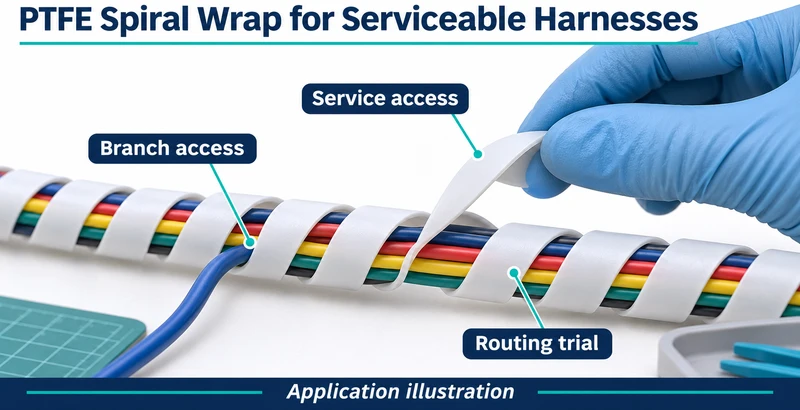
Application illustration. Not a customer photograph, test result or assembly rating.
A harness that needs regular access should be designed around its maintenance tasks. PTFE spiral wrap can be considered where an open wrap and branch access suit the equipment. The project still needs to define how technicians will inspect, open, reinstall or replace the wrap without compromising the cables underneath.
This guide focuses on service access after assembly. It does not assign a universal wear life or temperature rating to an installed harness.
List the actual service tasks
Identify which connectors will be disconnected, which branches may be added and which cable sections need inspection. Show the technician’s approach direction and available working space. A branch that looks accessible on a drawing may be obstructed by a bracket once the equipment is assembled.
Record whether the equipment remains stationary or the harness moves during operation. State the jacket materials, exposure conditions and any restrictions on handling. Establish the equipment’s isolation and maintenance procedure independently of the wrap selection.
Put branches on the harness drawing
Locate branch exits, identification labels, clamps and connector backshells. Check that the wrap does not pull a branch sideways or obstruct its bend and service access. Where several branches are close together, trial the layout on a representative bundle rather than extrapolating from a simple straight sample.
Do not rely on an open wrap as the sole strain relief. Cable supports, connectors and any dedicated strain-relief parts need their own design review. A wrap can organize a bundle while still allowing unwanted movement at a poorly supported connection.
| Maintenance question | What to demonstrate in the trial |
| Can the connector be reached | Access with the final bracket and label layout |
| Can a branch be serviced | No unacceptable side load or jacket interference |
| Can the wrap be opened | A defined method that does not damage cables |
| Can it be restored | Agreed fit and coverage after reinstallation |
| When must it be replaced | Observable inspection and disposition criteria |
Define opening and reinstallation
Decide whether technicians may unwind a section, remove a complete length or replace the wrap. Agree which tools and handling methods are permitted for the selected construction. Avoid assuming that any sample can be repeatedly opened without changes to fit or condition.
If reuse is intended, trial the planned maintenance sequence and inspect the wrap and cable jackets afterward. Define how many cycles the evaluation represents and what remains unqualified. Do not publish a reusable-cycle claim without supporting evidence for the relevant configuration.
Inspect the contact areas
Include branch exits, wrap ends, support points and any locations that contact equipment edges. Set practical acceptance criteria for cuts, loose fragments, permanent distortion and jacket damage relevant to the application. Compare condition before and after the agreed trial so installation damage is not confused with later wear.
Keep identification visible where technicians need it. Check the smallest bundle section as well as the largest; the service layout can change local fit. Document how replacement lengths and part numbers will be identified in maintenance instructions.
Match protection to the required function
The gaps in spiral wrap mean it should not be assumed to provide a sealed environmental barrier or a pressure-containing fluid path. If the application needs continuous coverage, compare a separately specified sleeve or FEP heat shrink tubing against the installation and service requirements. A recovered heat shrink sleeve may need replacement when access requires cutting it away.
Do not substitute a spring-shaped complete tube for spiral wrap because both look helical. Confirm the product construction and intended function on the drawing and quotation.
Illustrative maintenance review
Application demonstration, not a customer case: an equipment team needs access to a sensor branch during servicing. It checks connector clearance, support positions and the proposed wrap-opening method on a representative harness. Acceptance depends on the agreed fit and condition after the trial. No service-life improvement, time saving or test result is claimed.
Request a service focused sample
Send Yozonetech the bundle-size range, branch drawing, access constraints, materials, exposure and quantities. Explain whether the wrap is intended for reuse or replacement during maintenance. Our engineers can review candidate dimensions and help define the information needed for evaluation.
Send Yozonetech the drawing, material, required lengths, quantity and application conditions. Confirm availability, minimum order and packaging for the selected spiral-cut construction at quotation. Samples are free with courier charges collected from the recipient. Routine preparation is typically 3–5 days subject to specification and stock confirmation; custom production and transportation are agreed separately. EXW, FOB, CIF and DDP can be discussed for the destination. Request documents applicable to the selected product and use.
Contact Yozonetech: ptfetube@yozonetech.cn | https://www.chinaptfetube.com/