 +86-13752771911
 E-mail:ptfetube@yozonetech.cn




FEP Heat Shrink Import Documentation for UK and Polish Buyers
November 14, 2026
Yozonetech
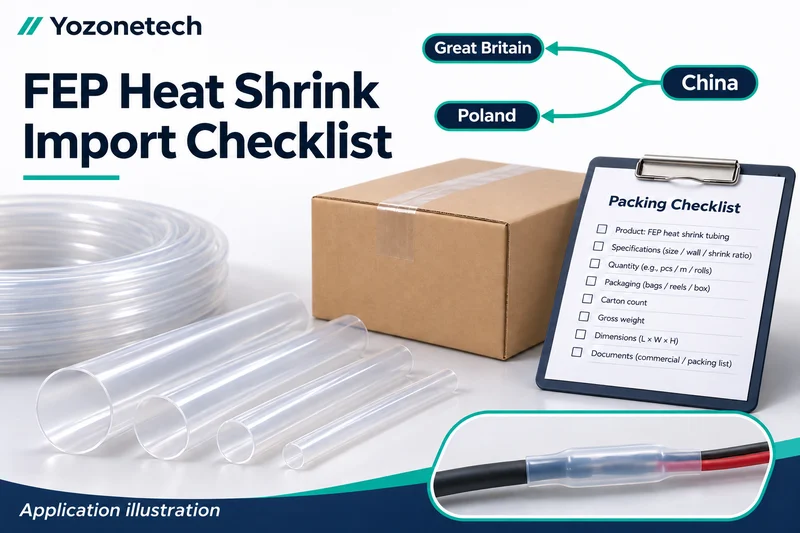
Application illustration. Not a customer photograph, test result or assembly rating.
When importing FEP heat shrink tubing from China, align the product specification, commercial documents and customs instructions before the shipment leaves. Buyers in Great Britain and Poland need different customs arrangements even when the tubing comes from the same supplier. This guide covers business purchases of unassembled sleeves; it does not assign a tariff code or guarantee clearance.
Describe the product accurately
Use a description such as “FEP fluoropolymer heat shrink tubing, unassembled sleeves” and add the actual item number, dimensions, supplied length and quantity. Define expanded inside diameter, recovered diameter limit, wall basis and cut length on the technical specification. Distinguish these sleeves from ordinary FEP tubing, which is a separate purchase specification.
Ask the broker what construction and use details are needed for classification. Provide a datasheet or drawing and disclose any lining, added components or special processing. A polymer name alone does not establish the destination commodity code. Confirm classification before calculating a landed price.
Prepare Great Britain imports separately
For England, Scotland and Wales, the importer needs a GB EORI number. Agree who will make the customs declaration and give the agent the correct importer details, goods description, commodity code and valuation information. Northern Ireland has separate arrangements and may require an XI EORI; confirm that route individually. See the official UK import process.
Use the UK Trade Tariff to check the agreed classification, origin and applicable measures. Import VAT must be addressed separately from the supplier’s product price; review the HMRC import VAT guidance with the importer or agent. Do not assume a Chinese export code is the complete UK import code.
Prepare Polish imports through the EU framework
An EU EORI is used for customs operations. Poland’s official PUESC EORI service explains registration and the use of an EORI already assigned in another EU country. Confirm registration and broker representation before dispatch.
Check the agreed classification and Chinese origin in the European Commission’s TARIC database. TARIC includes EU tariff measures and restrictions, but not national VAT rates. Ask the Polish agent to confirm the applicable import VAT treatment and clearance route. If goods enter the EU through another country, settle transit or clearance responsibilities before booking freight.
Assemble a consistent shipment file
The following is a practical preparation checklist. The broker determines which documents and data the actual entry requires. A quality file helps identify and accept the product; it does not replace the customs declaration.
| Record | Details to reconcile |
| Commercial invoice | Parties, description, quantity, value, currency, origin and agreed delivery term |
| Packing list | Item references, lengths, package count and weights matching the shipment |
| Transport record | Consignee, route and airway bill or bill of lading reference as applicable |
| Technical file | Approved drawing, product construction and dimensional limits |
| Import instructions | Importer, EORI, broker, classification and tax responsibility |
Agree delivery responsibilities in writing
Request a quotation with the named place or port and the agreed Incoterms edition. State who arranges transport, export formalities, import clearance and payment of duties and taxes. A DDP discussion should identify the workable importer and tax arrangement for the destination; the term alone does not resolve registration or representation requirements.
Keep customs acceptance separate from end-use approval. Ask for relevant REACH, RoHS or food-contact documentation only where applicable to the supplied grade and intended use. A management-system certificate or material statement does not establish every product’s regulatory suitability.
Apply the checklist before booking
Application demonstration, not a customer case: a distributor plans deliveries of the same FEP sleeves to Great Britain and Poland. The team keeps one approved technical specification but prepares separate importer and broker instructions for each destination. It reconciles invoice quantities with packed cut lengths before release. No clearance result, saving or delivery outcome is claimed.
Send a shipment ready inquiry
Send Yozonetech the destination postcode, importer location, sleeve dimensions, cut lengths, quantity, intended use and required records. Tell us whether you need samples before approval and which delivery term the broker can support.
Yozonetech offers heat shrink tubing with a minimum order of 100 m for small sizes and 50 m for larger sizes; confirm the size boundary and selected construction in the quotation. Samples are free with courier charges collected from the recipient. Routine preparation is typically 3–5 days subject to specification and stock confirmation; custom production and transport are agreed separately. Custom dimensions can be reviewed. EXW, FOB, CIF and DDP can be discussed for the destination and route. Request documents applicable to the supplied product and intended use.
Contact Yozonetech: ptfetube@yozonetech.cn | https://www.chinaptfetube.com/
Official sources checked on 14 November 2026. Reconfirm the rules, classification and tax treatment for the actual shipment date.