 +86-13752771911
 E-mail:ptfetube@yozonetech.cn




PTFE Spiral Cut Tubing Drawing Requirements and Incoming Inspection
November 12, 2026
Yozonetech
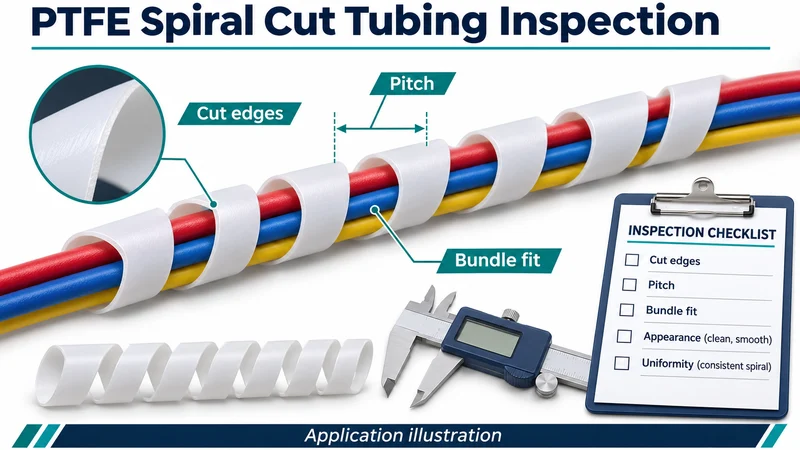
Application illustration. Not a customer photograph, test result or assembly rating.
A useful drawing for PTFE spiral cut tubing must define how the open wrap will be measured and accepted. A nominal diameter alone leaves the supplier and receiving team with different possible interpretations. The procurement task is to turn an approved bundle fit into dimensions, inspection conditions and repeat-order records.
Spiral-cut wrap is an open protective organizer. It is different from a complete tube formed into a spring and from a closed-wall convoluted tube. Do not use pressure or fluid sealing requirements as substitutes for wrap fit and edge quality.
Define the measurement condition
State whether dimensions apply to the uninstalled wrap at rest or to wrap installed on a defined fixture. Record the fixture shape, bundle-size range and installation method used during approval. An open spiral can change shape when stretched, so measurements made under different tension may not be comparable.
Use one unit system on the drawing and identify the revision. Distinguish tube or wrap dimensions from the outside envelope of the installed bundle. If a supplier uses a different dimension convention, resolve that difference before accepting the quotation.
Make the cut geometry unambiguous
Identify the material, wall requirement, diameter reference, pitch and cut direction where these affect installation. Define pitch as the axial advance of one complete turn under the agreed measurement condition. If strip width or installed gaps matter, describe their measurement separately rather than assuming they are the same as pitch.
Include the treatment of both ends. State whether cut length refers to the uninstalled supplied product or to the protected axial length on the harness. Those lengths should not be treated as interchangeable without an agreed reference installation.
| Drawing field | Acceptance detail to agree |
| Material and color | Ordered polymer and any restricted substitutions |
| Diameter and wall | Reference surfaces, limits and measurement condition |
| Pitch and cut direction | Definition, tolerance and inspection method |
| Supplied length | Uninstalled length basis and end condition |
| Bundle fit | Fixture, bundle range and installation method |
| Cut quality | Edge and cleanliness criteria for the intended contact |
Establish edge acceptance with the sample
Discuss burrs, loose fragments, sharp projections and damage that could interfere with the intended cable jacket. Do not impose an undefined requirement such as “perfect edges.” Agree a practical visual or magnified inspection method and any installation trial needed to assess the contact surface.
An approved sample can make an appearance requirement clearer, but it should supplement a controlled specification. Record what the sample demonstrates and which limits remain on the drawing. Do not assume a photograph establishes dimensional conformity or long-term abrasion performance.
Plan receiving inspection before delivery
Agree the sampling plan, measurement equipment and handling procedure. At receipt, compare the material designation, item number, drawing revision and supplied length with the order. Inspect packaging and the wrap ends before stretching or installing samples.
Use the same reference fixture and method agreed during approval for any fit check. Record deviations separately: a dimensional concern, an edge concern and a packaging concern may require different supplier actions. Keep nonconforming items identifiable while the parties review disposition.
Control repeat orders and changes
Link the purchase order to the drawing revision, approved reference and inspection requirements. Ask the supplier to identify proposed changes to material, cut geometry or finishing before supplying affected goods. Agree when a new sample is required and who can approve an alternative.
An acceptable fit on one bundle does not qualify every diameter, jacket material or branch layout. Keep a list of approved applications where this distinction matters to production.
Illustrative incoming inspection exercise
Application demonstration, not a customer case: a receiving team finds that a wrap’s pitch appears different from the approved sample. Before rejecting or accepting the lot, the team checks that both were measured at the same extension and under the same procedure. It then records the result against the drawing limits and asks the supplier to review any remaining discrepancy. No measurement result or customer outcome is assumed.
Prepare a drawing for quotation
Include the dimension definitions, installation reference, inspection method and quantities. If a requirement is not yet defined, our engineers can review the application and suggest suitable options for sample evaluation.
Send Yozonetech the drawing, material, required lengths, quantity and application conditions. Confirm availability, minimum order and packaging for the selected spiral-cut construction at quotation. Samples are free with courier charges collected from the recipient. Routine preparation is typically 3–5 days subject to specification and stock confirmation; custom production and transportation are agreed separately. EXW, FOB, CIF and DDP can be discussed for the destination. Request documents applicable to the selected product and use.
Contact Yozonetech: ptfetube@yozonetech.cn | https://www.chinaptfetube.com/