 +86-13752771911
 E-mail:ptfetube@yozonetech.cn




Smooth Bore Convoluted and Braided PTFE Tubing Choosing the Construction
November 10, 2026
Yozonetech
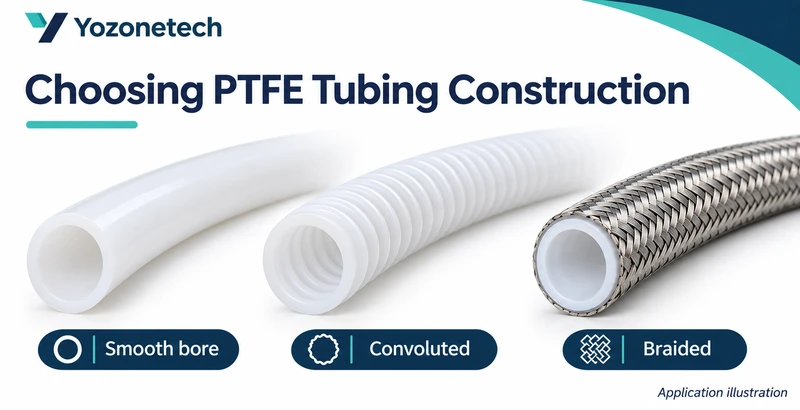
Application illustration. Not a customer photograph, test result or assembly rating.
Choosing a PTFE tube construction requires two separate decisions: the internal flow-path geometry and the external reinforcement. Smooth bore PTFE tubing, convoluted PTFE tubing and PTFE braided hose are useful categories, but they are not mutually exclusive. A braided hose may have either a smooth or a convoluted liner.
Start with the application, then identify which bore and reinforcement arrangement has evidence for the required duty. Appearance and the polymer name do not establish assembly performance.
Separate the bore from the braid
A smooth bore describes the internal surface profile. A convoluted tube has a formed geometry whose internal and external profiles should be confirmed from the selected product drawing. Braid describes reinforcement outside the liner, not the shape of the fluid passage.
This distinction matters in quotations. “Braided PTFE hose” does not tell the buyer whether the liner is smooth or convoluted. Ask for the construction drawing or a clear specification. Also distinguish a closed-wall convoluted tube from spiral-cut wrap, which has an open cut and should not be specified as a pressure-containing fluid line.
Define the project requirements
Identify the medium, concentration, temperature, pressure, vacuum and required flow. Include cleaning conditions and any particle or residual-fluid limits relevant to the process. Record whether the application is static, intermittently repositioned or continuously moving.
Provide a routing sketch with connection positions, available bend space and support locations. A tube that can be bent by hand is not automatically qualified for repeated motion. Obtain minimum bend guidance and any dynamic-use evidence for the actual construction and size being considered.
| Construction question | What the project must confirm |
| Smooth internal passage needed | Bore geometry, connections and flow requirements |
| Formed tube considered for routing | Actual profile, bend guidance and motion duty |
| External reinforcement required | Assembly rating and reinforcement construction |
| Vacuum service required | Collapse resistance for the selected tube and conditions |
| Cleaning is critical | Retention, cleaning method and acceptance criteria |
Evaluate the internal passage
For a smooth bore candidate, confirm the actual ID and dimensional limits along with fitting compatibility. A smooth appearance does not prove that the complete assembly meets a specified flow or cleaning requirement.
For a convoluted candidate, review the internal geometry and any application-specific concerns about retained liquid, particles or cleaning. Ask for the information needed to assess flow behavior rather than assigning a generic pressure-drop advantage or disadvantage to every product in the category. Compare candidates at the proposed length, dimensions and duty.
Evaluate reinforcement as part of the assembly
Where pressure duty or installation exposure leads the engineer to consider braid, identify the braid material, liner and compatible fittings together. Reinforcement does not create one universal pressure rating. The hose, ends and assembly process must be reviewed as a combination.
External abrasion, twisting and tight bends also need attention. Follow guidance for the selected construction, and do not use braid as a substitute for suitable supports or routing. If vacuum matters, request evidence for that service separately; a pressure rating alone does not establish resistance to collapse.
Compare representative installation trials
Use the proposed tube size, connections and route. Define the checks before testing: fit, bend condition, access for maintenance, and any required leak, flow or cleaning assessment. Record the procedure and acceptance limits so purchasing can repeat the approved specification.
Application demonstration, not a customer case: an equipment team has a confined route and initially requests “flexible PTFE hose.” Engineering separates the choice into bore profile, reinforcement and end connections. Each candidate is reviewed against the same duty and routing sketch. No winner or test result is assumed before evaluation.
Prepare a useful quotation request
Send Yozonetech the dimensions, length, medium, pressure and temperature conditions, vacuum requirements, routing sketch and quantity. Include whether the quote should cover plain tubing, bulk reinforced hose or finished assemblies. Our engineers can review open requirements and recommend candidate constructions for approval.
Extruded tubing starts from a 1 m minimum order and many common sizes are held in stock; availability for formed tubes and braided constructions is confirmed by specification. Samples are free with courier charges collected. Routine preparation is typically 3–5 days subject to stock and specification confirmation, with custom production and transportation agreed separately. EXW, FOB, CIF and DDP can be discussed. Request applicable product documents for the selected use.Contact Yozonetech: ptfetube@yozonetech.cn | https://www.chinaptfetube.com/