 +86-13752771911
 E-mail:ptfetube@yozonetech.cn




Specifying Silicone Reinforced Tubing Connections and Wall Thickness
Октябрь 30, 2026
Yozonetech
Specify silicone reinforced tubing together with the connection it must fit. The bore, outside diameter, reinforcement and retention method all affect the assembly. A drawing and an agreed sample check give the supplier a much clearer requirement than a request for a nominal hose size alone.
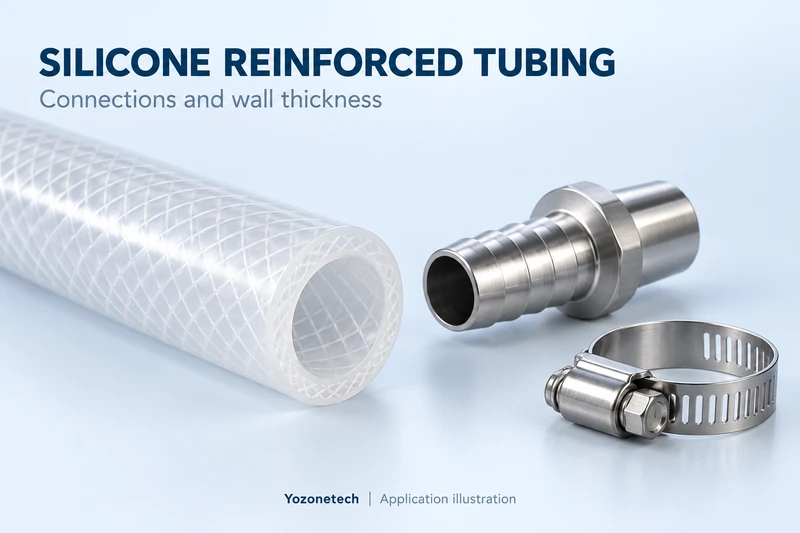
This guide helps buyers prepare a request for silicone reinforced tubing and review proposed connections. Numerical examples are hypothetical purchasing exercises, not Yozonetech stock specifications, pressure ratings or customer test results.
Define the tube construction and service
State the silicone compound or grade requirement and the type of reinforcement needed. A textile braid embedded in the wall and a wire reinforcement are different constructions; do not use the word reinforced as a complete specification. Ask the quotation to identify the offered construction, including any outer cover.
Provide the actual liquid or gas, concentration, normal temperature, peak temperature and cleaning exposure. State maximum working pressure, transients and any vacuum. If the tube repeatedly bends or moves, describe the motion and surrounding space. A silicone material temperature reference cannot establish the permitted pressure of a reinforced tube or its end connection.
If a project needs food-contact, regulatory or cleanliness documentation, identify the intended contact conditions and request the applicable product documents. The silicone material name alone does not establish suitability for every food, medical or pharmaceutical application.
Name ID OD and wall separately
ID is the internal diameter, and OD is the overall outside diameter of the supplied tube. For an ideal circular concentric tube, nominal total wall equals (OD − ID) ÷ 2. This describes geometry; it does not reveal braid coverage, reinforcement position or minimum local silicone thickness.
List all dimensions in a consistent unit system. An order reading “10 mm silicone hose” leaves it unclear whether 10 mm means ID, OD or a nominal connection size. Write the dimension labels and tolerances on the purchase drawing. Add length, cut-end requirements and whether the hose must arrive as continuous lengths or cut pieces.
| Hypothetical tube | ID | OD and calculated total wall |
| A | 10 mm | 16 mm OD gives 3 mm wall |
| B | 10 mm | 18 mm OD gives 4 mm wall |
Both examples have the same nominal bore. They have different external envelopes and may need different retention components or installation space. The thicker example is not automatically the correct choice, and the calculation does not demonstrate greater working pressure.
Obtain the mating fitting drawing
Ask for the fitting’s actual geometry, including barb crest diameter, stem diameter, insertion length and the area intended for retention. Identify the fitting material and surface condition. A fitting sold under the same nominal size as the tube is not sufficient evidence of compatibility with that particular reinforced construction.
Share the fitting drawing with the tube supplier before ordering. Reinforcement can limit expansion during insertion, so a fitting that is easy to insert into an unreinforced tube may not behave the same way with a reinforced one. The acceptable fit must be reviewed for the specific tube, fitting and operating conditions.
Do not derive a universal interference percentage from the nominal ID. A sufficiently secure assembly must also avoid damaging the liner or reinforcement. If an insertion aid is proposed, agree its compatibility with the tube and process rather than selecting a lubricant without review.
Select retention for the assembled geometry
Agree the retention method, such as an appropriate clamp or a supplier-designed fitting system. The selected component must fit the installed outside diameter, which can differ from the free tube OD after the hose is placed over a barb. A clamp range checked only against the uninstalled hose may therefore be misleading.
Confirm the permitted clamp position, installation procedure and any tightening specification with the assembly supplier. Do not invent a torque value from hose diameter. Excessive local compression can damage a soft tube, while insufficient retention can leave the connection unreliable. Avoid substituting a clamp solely because its catalog size range overlaps.
For a crimped or otherwise engineered assembly, request the complete approved combination and assembly instructions. A loose hose, fitting and retention component purchased separately do not inherit a working rating simply by being combined.
Use a connection review matrix
The following exercise concerns a proposed 10 mm ID tube in a machine with limited space around a port. No medium, pressure or operating temperature has been approved. The purpose is to identify information that blocks an engineering decision before samples are purchased.
| Buyer input | What it resolves | What remains to confirm |
| 10 mm nominal ID | Starting bore requirement | ID limits and fitting compatibility |
| Choice of 16 or 18 mm OD | Free tube envelope | Installed OD and retention fit |
| Existing hose barb | Intended connection style | Actual geometry and insertion depth |
| Restricted port area | Routing constraint | Bend radius and access for assembly |
The next step is to send the port and fitting drawings together with operating conditions. Neither OD option can be approved from this matrix alone. That is a useful outcome: the buyer can request the missing information before treating two quotations as equivalent.
Define a sample acceptance plan
Agree dimensional inspection conditions, instrument suitability and how soft tubing will be measured without excessive deformation. Record ID and OD at agreed locations, cut length and visual condition. If local wall or reinforcement position is critical, specify a suitable inspection method and acceptance limits rather than assuming the nominal wall calculation proves uniformity.
Trial the selected tube with the actual fitting and retention components. Check insertion, installed envelope, routing and access. Identify any damaged surfaces, exposed reinforcement or unintended sharp bends. Then perform the agreed leak, retention or other functional tests under a procedure suited to the application. Test pressure, duration, medium and acceptance limits must be agreed; they are not supplied by the hypothetical dimensions in this article.
If the service includes temperature changes, movement or cleaning, include representative conditions in qualification. A room-temperature fit check cannot establish performance throughout a demanding duty cycle. Keep the approved sample identification, drawing revision and assembly method with the purchasing record.
Compare complete quotations
Ask each supplier to quote the same tube construction, dimensional limits, supply length and connection scope. Separate bare tubing from finished assemblies. Identify which party provides fittings and performs assembly and testing. Confirm documentation, packaging, quantity and destination so that a lower unit price does not conceal a different supply scope.
Yozonetech has reinforced tubing inventory, with stock and minimum order quantity confirmed for the exact specification. Custom dimensions can be discussed subject to technical review. Samples are free with courier charges collected from the recipient. Regular supply is typically 3–5 days subject to stock and specification confirmation; custom production and transport are discussed separately. EXW, FOB, CIF and DDP can be discussed for the shipment.
Send the tube and fitting drawings, operating conditions and quantity to ptfetube@yozonetech.cn or contact Yozonetech. Request applicable FDA-related, REACH and RoHS documents and the current ISO 9001 certificate where relevant to your purchasing requirements.