 +86-13752771911
 E-mail:ptfetube@yozonetech.cn




PTFE Stainless Steel Braided Hose Selection and Purchasing Guide
Октябрь 29, 2026
Yozonetech
A purchase request for “PTFE stainless steel braided tubing” describes a product family, but it does not yet define the hose a machine or project needs. Start by agreeing the medium, operating conditions, dimensions and end connections. Then ask the supplier to confirm an appropriate construction and an assembly specification.
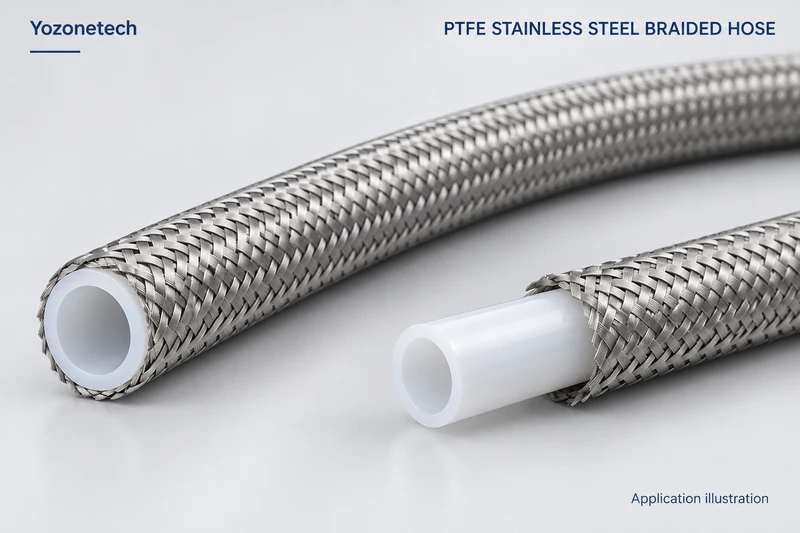
This guide helps engineering buyers prepare a usable request for PTFE stainless steel braided hose, compare offers on the same basis and plan sample acceptance. The worked example is an application exercise, not a customer project or a product rating.
Define the duty before choosing the construction
State the exact liquid or gas, concentration, cleaning agents and any change of medium. Record continuous and peak fluid temperatures, ambient temperature, maximum operating pressure, transients, vacuum and whether the hose moves in service. Identify vibration, rubbing, external chemicals and the available installation space.
Use explicit units. “High pressure” and “high temperature” leave the supplier unable to assess the requirement. Also distinguish a bare hose supplied in a coil from a finished assembly with installed fittings. The scope changes what must be designed, tested and quoted.
Describe the liner braid and outer covering separately
The liner is the fluid-contact layer. Specify PTFE and discuss whether a smooth-bore or convoluted construction is required. The stainless steel braid is a separate reinforcement layer. Identify the required wire material and construction rather than assuming that every silver braid is equivalent.
If an outer protective covering is needed, describe its purpose: abrasion protection, washdown, identification or another requirement. It also needs to suit the external exposure. Do not assume that a covering changes the liner’s chemical compatibility or establishes a new pressure rating.
Where electrical conductivity or static control matters, make it an explicit requirement for technical review. A visible metal braid does not establish that the fluid-contact liner or the assembled system has the required electrical performance.
| Part of the specification | Information to agree |
| Inner liner | PTFE construction, bore form, ID, wall and dimensional tolerances |
| Reinforcement | Stainless steel grade, braid construction and applicable performance evidence |
| Outer covering | Whether required, material, thickness and environmental exposure |
| Connections | End type, thread or flange details, sealing method, material and orientation |
Put dimensions into a controlled drawing
List the liner ID, any required liner OD, overall hose OD and the relevant tolerances. Do not confuse liner OD with the final diameter over braid or covering. Where only one diameter is functionally critical, state which one and why.
For a concentric circular liner, nominal wall thickness equals (OD − ID) ÷ 2. An illustrative 6 mm ID and 8 mm liner OD gives a 1 mm nominal liner wall. This calculation says nothing about the braid thickness, assembly OD or permitted working pressure, and it is not a stock confirmation.
For finished assemblies, define the measurement datum for overall length. Include fitting angle and orientation, length tolerance, free hose length and installation routing. A port-to-port distance alone may not allow enough space for the required bends or movement.
Confirm pressure at the actual operating temperature
Ask for written working-pressure confirmation for the selected size, construction, fittings and temperature. A burst-test value is not a working-pressure rating. The selected assembly must account for the maximum system pressure, including identified transients, and any component limitations.
Request the test basis, conditions and applicable acceptance criteria when pressure evidence is required. Do not infer an allowable pressure from the PTFE resin’s temperature capability or from a different hose diameter. Vacuum capability also needs its own confirmation; braid alone is not proof of resistance to collapse.
As a general engineering reference, the Parker Safety Guide distinguishes working pressure from burst pressure and asks users to consider temperature, compatibility and assembly conditions. Its product data do not rate a Yozonetech hose.
Application exercise for an equipment connection
Assume a project team needs a 6 mm nominal bore for a compatible liquid, at 60°C, with 6 bar gauge continuous pressure and identified peaks of 8 bar gauge. The assembly length is provisionally 1,000 mm, but end details and routing remain open. These are fictional buyer inputs, not verified service conditions or Yozonetech performance figures.
| Illustrative buyer input | Required follow-up |
| 6 mm nominal bore | Confirm flow requirement, tolerance and a proposed liner construction |
| 60°C fluid temperature | Request assembly performance at this temperature |
| 6 bar gauge normal and 8 bar gauge peak | Review the peak and pressure-cycle profile when selecting the assembly |
| 1,000 mm provisional length | Define end connections, length datums, bend space and movement |
The useful next step is a completed application sheet and proposed assembly drawing. This example does not approve a hose for those conditions. Compatibility, installation and the supplier’s confirmed assembly limits remain part of the review.
Agree sample checks and delivery requirements
Before approving a sample, compare material identification, dimensions, fitting details, length and visible condition with the drawing. For a project requiring pressure, leak, electrical or other tests, agree the method, test conditions, sample quantity and acceptance limits in advance. A sample that looks correct is not a substitute for the specified checks.
Request ISO 9001 documentation and any applicable product-specific FDA-related, REACH or RoHS supporting documents. Match each document to the product, material and intended use. A standard named in a product description does not replace evidence for the ordered construction or assembly.
Yozonetech holds braided hose stock; confirm the selected size, quantity, MOQ and whether fittings are included. Samples are free, with courier charges payable by the recipient. The normal stated lead time is 3–5 days, subject to stock, specification and quantity confirmation. Custom assemblies, special tests and international transport need separate confirmation.
Send a complete quotation request
Include the medium and concentration, operating temperatures, normal and peak pressure, vacuum conditions, ID and overall OD constraints, hose construction, end drawings, assembly length and tolerance, routing, movement, test requirements, quantity and delivery destination. Ask for an itemised scope so that different offers can be compared fairly.
EXW, FOB, CIF and DDP quotation options can be discussed for the shipment. Contact Yozonetech at ptfetube@yozonetech.cn with your requirements, or review our PTFE stainless steel braided hose page as the starting point for a technical inquiry.