 +86-13752771911
 E-mail:ptfetube@yozonetech.cn




A Project Decision Workflow for PTFE FEP and PFA Tubing
Ноябрь 17, 2026
Yozonetech
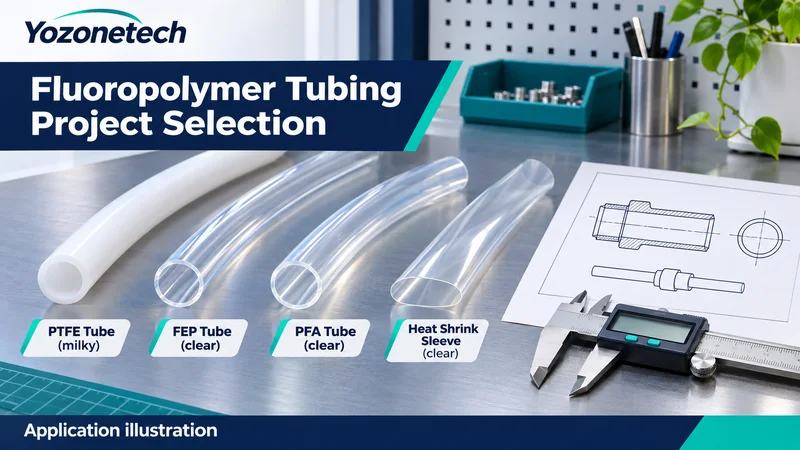
Application illustration. Not a customer photograph or a dimensioned installation design.
A useful project workflow for Трубки из ПТФЭ, Трубки FEP и Трубки PFA begins with the required function and ends with an approved assembly specification. Polymer names help build a candidate list, but the final choice depends on dimensions, connections, exposure and evidence for the actual use.
Gate one define the function
Decide whether the product carries fluid, acts as a liner, protects a surface or covers a component. Ordinary tubing and FEP heat shrink tubing solve different construction problems. Do not select a shrinking sleeve as though it were a qualified fluid line.
Record the consequence of a wrong fit or an unsuitable material. This helps the responsible engineer choose the evidence needed before purchase. If the function is still unclear, resolve it before comparing price lists or requesting a particular polymer.
Gate two document the operating envelope
For fluid service, identify the medium, concentration, continuous and peak temperature, pressure, vacuum, flow and cleaning conditions. For component protection, identify surface contact, electrical requirements, exposure and installation heat limits. Include duration and repeated cycles where relevant.
Use these conditions to screen candidate products with engineering. Request compatibility and rating information for the selected grade and size. A resin property table is not a finished assembly qualification, and a material temperature range is not a pressure rating.
| Decision gate | Record needed before progressing |
| Function | Fluid liner cover or shrinking sleeve |
| Duty | Exposure temperature pressure and duration as applicable |
| Geometry | Dimensions tolerance route and interfaces |
| Evidence | Inspection and representative trial criteria |
| Release | Approved drawing product and process references |
Gate three establish geometry and interfaces
Define bore, outside diameter, wall and length requirements together with the route. Add connection details, support locations and installation access. A tube may fit the available space yet still need a different fitting or handling method.
For heat shrink, measure the largest obstruction the supplied sleeve must pass and the smallest region requiring contact. Confirm expanded and recovered limits, finished coverage and allowable axial movement. Check whether the component can tolerate the installation cycle before approving the sleeve.
Gate four compare only relevant candidates
Compare FEP and PFA when their offered grades and sizes are candidates for the specified duty. Compare PTFE and FEP when the actual dimensional, interface or protection requirements make that comparison useful. Avoid a universal ranking of the three polymers.
Ask suppliers to distinguish declared characteristics from demonstrated results. If transparency matters, define the intended inspection task and approve a representative sample. If cleanliness matters, identify the acceptable handling, packaging and evidence rather than relying only on a material label.
Gate five approve representative evidence
Agree the inspection and application trial before obtaining samples. Use the proposed dimensions, interfaces and operating conditions where needed. Record the procedure and acceptance criteria so a later production order can refer to the same requirements.
If an application needs leak, pressure, electrical or environmental checks, the responsible engineer should specify the method and limits. A fit check alone does not prove long-term service suitability. Keep any remaining open requirement visible at the approval stage.
Gate six release a complete specification
Connect the chosen product to the drawing revision, approved sample, installation instruction and required delivery records. Define which changes need review. Purchasing can then compare offers on the same supply scope and repeat the order without recreating the decision from email fragments.
Application demonstration, not a customer case: an equipment team considers a transparent tube and a protective sleeve for separate functions. It creates two item records, screens the duty for each and plans separate trials. No winning polymer or test outcome is assumed before evaluation.
Ask for a project review
Send Yozonetech the function, drawing, duty and quantity, including the requirements still awaiting approval. Our engineers can help identify missing information and suggest candidates for your assessment. The workflow supports a documented project decision rather than replacing the engineer’s approval.
Extruded tubing starts from a 1 m minimum order, and most common sizes have stock. Confirm availability for the exact large diameter, wall and length; common-size stock does not imply every large pipe is available. Samples are free with courier charges collected. Routine preparation is typically 3–5 days subject to specification and stock confirmation; custom production and transport are agreed separately. Heat shrink minimum orders are 100 m for small sizes and 50 m for larger sizes; confirm the boundary at quotation. Custom dimensions can be reviewed. EXW, FOB, CIF and DDP can be discussed with the named destination and clear responsibilities. Request documents applicable to the selected product and intended use.Contact Yozonetech: ptfetube@yozonetech.cn | https://www.chinaptfetube.com/