 +86-13752771911
 E-mail:ptfetube@yozonetech.cn




Large Diameter FEP Pipe for Indian Projects Packing Freight and Acceptance
November 16, 2026
Yozonetech
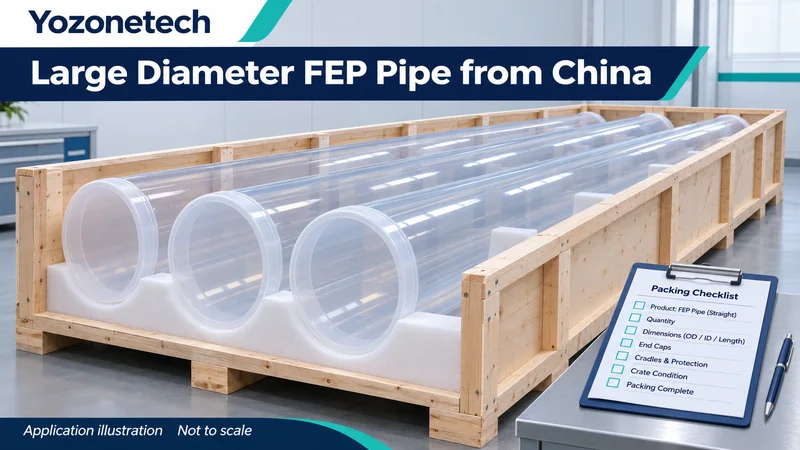
Application illustration. Not a customer photograph or a dimensioned installation design.
For Indian projects buying large diameter FEP tubing from China, agree the packing geometry and receiving criteria before comparing freight prices. A useful order connects the approved tube drawing to a package that can be handled along the entire route. Diameter alone does not define the shipment or the finished product duty.
Start with the approved supply form
Specify inside and outside diameters, wall limits, cut length, quantity and acceptable dimensional variation. State whether straight lengths are required or whether an agreed coiled form is acceptable. Do not let the forwarder choose a coil size merely to fit a cheaper package. Confirm the permitted packing bend condition with the supplier for the actual size.
Record the drawing revision and the measurement condition for ovality or straightness where these affect installation. Include end preparation and cleanliness requirements. If the tube is a liner or protective conduit, say so explicitly; do not allow a quotation description to imply a qualified pressure pipe assembly.
Design packing around the receiving route
Ask for proposed package dimensions, gross weight, lifting arrangement and end protection before booking. Discuss broad support surfaces and restraint that avoids concentrated loading. Review how the product will be removed without dragging it over rough edges or cutting it with packing tools.
Check restrictions at the destination as well as at the port: vehicle access, lifting equipment, storage space and the longest piece that can enter the work area. For long straight sections, a package that is acceptable to the carrier may still be impractical at the site. Obtain the receiving team’s approval of the proposed unloading method.
| Procurement field | Evidence to agree before dispatch |
| Tube specification | Approved diameter wall length and revision |
| Supply form | Straight or agreed coil with packing conditions |
| Protection | End covers supports and restraint arrangement |
| Freight basis | Package dimensions weight and handling needs |
| Receiving | Inspection method limits and reporting process |
Prepare the Indian import file
For a commercial import, confirm the importer’s IEC position, including any applicable exemption, with the Indian broker. The DGFT IEC manual describes the importer identification system. Check the actual product classification, import policy and current duties for the shipment; this guide does not assign a tariff code or tax rate.
Align the commercial invoice, packing list and transport document with the item references and packed quantities. The official ICEGATE FAQ explains import documentation, including the accepted invoice and packing-list combination. Have the broker identify additional records required for the actual entry. These official sources were checked on 15 November 2026.
Compare quotations on the same delivery scope
Request the named place or port, delivery term and agreed Incoterms edition. Compare product value, packing, freight and destination charges using the same scope. For DDP discussions, identify the workable importer and tax arrangement rather than treating a price label as a complete clearance plan.
Separate preparation time from transport and customs time. Confirm whether the quoted date is dispatch readiness or delivery at the destination. If the project has staged installation dates, discuss split shipments and the identification needed to match each package to its approved item.
Agree inspection before the shipment moves
At receiving, record package condition before opening, then verify item identity, quantity, length and the agreed dimensional checks. Document visible deformation, damaged ends or contamination before installation. Agree how a discrepancy will be reported and assessed; do not make acceptance depend only on a transport photograph.
If the application needs pressure, vacuum, chemical or electrical qualification, specify that evidence separately for the actual construction and conditions. A material temperature range is not a finished pipe pressure rating. Product acceptance and customs release are separate decisions.
Confirmed Mumbai supply experience
Yozonetech supplied large diameter FEP pipe for a railway construction project in Mumbai, India. The customer reported that the process from quotation through testing went smoothly. This confirmed experience does not establish a particular diameter, pressure rating, railway qualification or test procedure; those details have not been provided.
For your project, send the drawing, required lengths, quantities, installation purpose, destination and receiving constraints. Our engineers can help clarify open specification questions before the packing and freight plan is finalized.
Extruded tubing starts from a 1 m minimum order, and most common sizes have stock. Confirm availability for the exact large diameter, wall and length; common-size stock does not imply every large pipe is available. Samples are free with courier charges collected. Routine preparation is typically 3–5 days subject to specification and stock confirmation; custom production and transport are agreed separately. Custom dimensions can be reviewed. EXW, FOB, CIF and DDP can be discussed with the named destination and clear responsibilities. Request documents applicable to the selected product and intended use.
Contact Yozonetech: ptfetube@yozonetech.cn | https://www.chinaptfetube.com/