 +86-13752771911
 E-mail:ptfetube@yozonetech.cn




Large Diameter FEP Pipe Defining Supports Interfaces and Handling
November 16, 2026
Yozonetech
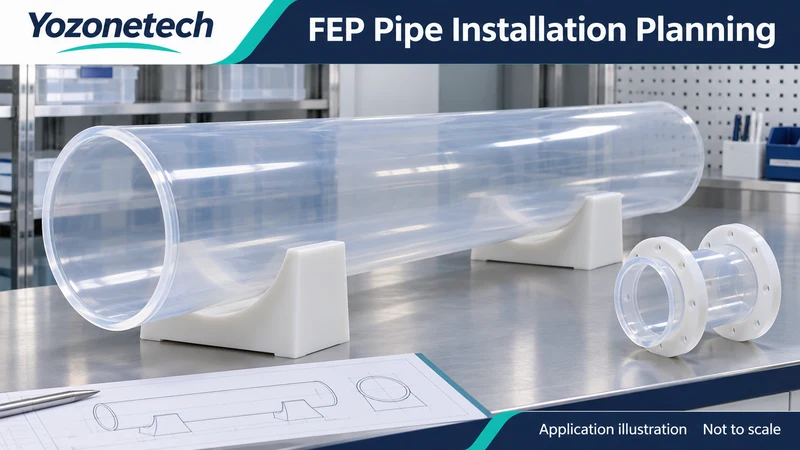
Application illustration. Not a customer photograph or a dimensioned installation design.
A project using large diameter FEP pipe should define the supports, interfaces and handling method together with the tube dimensions. These choices determine what must be reviewed before purchase and what must be checked during installation. This guide is a planning framework; support spacing and connection ratings require review for the actual assembly.
Define what the pipe must do
State whether the FEP component carries a fluid, lines another structure or provides a protective route. Identify the medium, concentration, operating and cleaning conditions, pressure or vacuum, and expected movement where applicable. A transparent tube appearance cannot establish suitability for that duty.
Prepare a route drawing showing elevations, changes in direction, access points and connection locations. Identify whether the tube is supported by another pipe or exposed along the route. Include the space needed to install and later replace each section, not just the space occupied during operation.
Review supports for the actual dimensions
Ask the responsible engineer and supplier to evaluate diameter, wall, unsupported length, contents and service conditions together. Do not transfer metal pipe support spacing to a polymer tube without review. Where the design needs movement accommodation, identify fixed and sliding locations on the drawing.
Specify smooth contact surfaces and review concentrated loads from clamps or narrow edges. Consider how the tube will be retained without assuming that tighter restraint is always better. Approve support geometry on a representative section and record the conditions used for the assessment.
| Design input | Question for the project team |
| Function | Fluid transport liner or protective route |
| Loads | Tube contents external loads and movement |
| Supports | Contact geometry restraint and spacing review |
| Interfaces | Dimensions connection method and evidence |
| Access | Installation removal and inspection space |
Define each interface on a drawing
Specify the mating component, connection method, dimensional tolerances and any sealing element. Ask for compatibility and assembly guidance for the offered size. Ordinary tube, a lined component and a fitted pipe assembly are different supply scopes and need different acceptance records.
Do not assume a method used on another fluoropolymer or a smaller diameter will work unchanged. If a formed or joined end is proposed, obtain the process and qualification information needed for that interface. Have engineering approve the complete connection before ordering production lengths.
Plan handling before unloading
Agree how the section will be lifted, supported and moved into position. Protect the ends and internal surface according to the cleanliness requirement. Avoid specifying a tight packing or installation bend without supplier review of the actual product.
Keep a clear opening procedure for crates and restraints so tools do not contact the tube. Inspect the receiving condition before the pipe is carried into an inaccessible area. Record identification and drawing revision while the label is still available, then preserve traceability through installation.
Establish assembly acceptance
Choose dimensional and visual checks that match the installation requirements. If the system needs leak, pressure, vacuum or flow checks, the responsible engineer must define the method, medium, duration and limits. Do not derive a test pressure from a generic resin property or an unqualified multiplier.
Confirm temperature and chemical suitability for the selected tube, connections and seals together. The lowest applicable assembly limit matters. A material operating-temperature statement does not establish a pressure rating or the acceptability of a particular support arrangement.
Illustrative route review
Application demonstration, not a customer case: a proposed equipment route includes a long FEP section between two connections. The team marks support locations, access space and movement requirements before selecting the connection detail. It plans a representative fit review and defines the acceptance criteria before testing. No support interval, successful test or performance improvement is assumed.
Prepare a project inquiry
Send Yozonetech the diameter and wall requirements, section lengths, route drawing, connection details and quantity. Explain the function and operating envelope, and identify what the project engineer still needs to approve. Our engineers can suggest which specification questions should be resolved for a suitable quotation.
Extruded tubing starts from a 1 m minimum order, and most common sizes have stock. Confirm availability for the exact large diameter, wall and length; common-size stock does not imply every large pipe is available. Samples are free with courier charges collected. Routine preparation is typically 3–5 days subject to specification and stock confirmation; custom production and transport are agreed separately. Custom dimensions can be reviewed. EXW, FOB, CIF and DDP can be discussed with the named destination and clear responsibilities. Request documents applicable to the selected product and intended use.Contact Yozonetech: ptfetube@yozonetech.cn | https://www.chinaptfetube.com/