 +86-13752771911
 E-mail:ptfetube@yozonetech.cn




Custom PTFE Tubing from China Tolerances Lengths and Quotation Tradeoffs
Novembro 9, 2026
Yozonetech
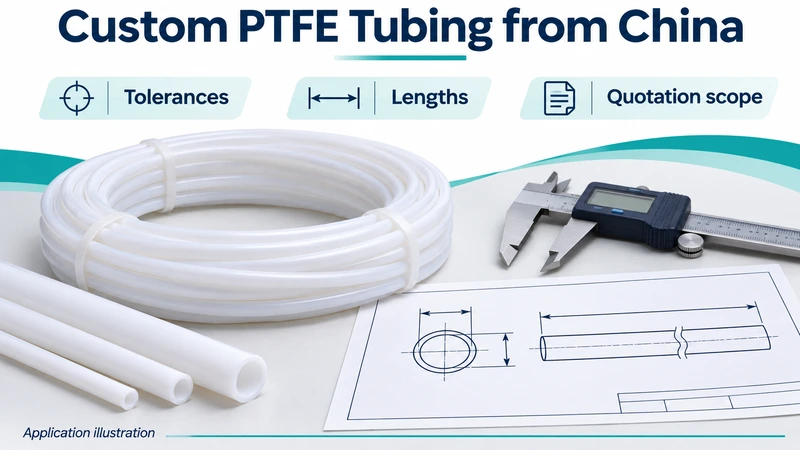
Application illustration. Not a customer photograph, test record or product performance guarantee.
When sourcing tubos de PTFE personalizados from China, the lowest price per metre is meaningful only when suppliers quote the same drawing, length arrangement and inspection scope. A tighter tolerance, a shorter cut length or a different packaging requirement can change the work involved even when the material name remains PTFE.
The useful purchasing question is which requirements protect the assembly’s function and which can be discussed with the supplier. Define those requirements before comparing quotations.
Start with the dimensions that control function
Identify inside diameter, outside diameter, wall requirements and the dimension that matters most to the application. A bore may control passage or fit, while an outside diameter may control a connection. Explain the purpose so the supplier can review manufacturability against the actual requirement.
For a concentric round tube, nominal wall thickness is half the difference between OD and ID. With an illustrative 4 mm OD and 2 mm ID, nominal wall is 1 mm. This is a geometric example, not a stock size or a tolerance guarantee. Independent ID and OD limits can allow a range of wall conditions, and nominal values alone do not establish minimum wall around the circumference.
If minimum wall, concentricity or ovality matters, define it explicitly. Avoid creating conflicting drawing limits by specifying ID, OD and wall independently without checking how those limits interact. Ask engineering and the supplier to resolve inconsistencies before the quotation is finalized.
Agree how dimensions will be inspected
The acceptance method should suit a flexible polymer tube. Ask how samples are prepared and conditioned, which instrument or gauge is used and how the tube is supported. Discuss any difference between coil form and a straight sample. A measurement procedure should not unintentionally deform the section being evaluated.
Agree sampling locations, reporting requirements and whether records need to be linked to the delivered batch. For small bore or thin wall constructions, a headline capability from a catalogue does not establish the achievable tolerance for every combination of dimensions and length. Obtain confirmation against the actual drawing.
| Quotation input | What to agree before price comparison |
| Drawing revision | Same controlled revision for all suppliers |
| Dimensional limits | Functional ID, OD and any minimum wall requirement |
| Inspection | Method, sampling and required records |
| Supplied form | Coil length, straight lengths or cut pieces |
| End condition | Cut quality and any finishing requirement |
| Packing and delivery | Protection, labels, destination and shipment scope |
Compare coil supply with cut lengths
Specify whether the total quantity can be supplied across several coils or must include uninterrupted lengths. An order for a total number of metres does not establish a minimum continuous length per coil. State how joints or length shortages will be handled, if relevant to your application.
For cut pieces, specify length tolerance, end condition and quantity in pieces. Clarify whether the buyer will perform final trimming. Compare the delivered cost of finished pieces with coil supply plus the buyer’s cutting and inspection work. Do not assume either route is always less expensive.
Separate standard and custom quotation options
Ask for one quote against the exact drawing and, where engineering allows it, an alternative using a confirmed standard size or different supplied length. Keep deviations visible. A proposed alternative becomes acceptable only after the buyer reviews the effect on fitting, routing, wall condition and other functional requirements.
Request separate identification of any tooling, setup, sampling, inspection or special packaging charges that apply. Do not assume a new tool is required for every custom inquiry. The supplier should confirm what is needed for the selected geometry and order size.
Approve the sample and control repeat orders
An approved sample should identify material, dimensions, drawing revision and supplied form. Record any differences between the trial sample and the planned production delivery. Repeat orders should reference the approved specification rather than asking for “the same tube” without a revision or item number.
Illustrative purchasing exercise: a buyer needs short PTFE sleeves and initially requests an unnecessarily tight overall length tolerance. This is a hypothetical scenario. Engineering reviews how the sleeve sits in the assembly and identifies which dimension is functional. Purchasing then asks for two clearly described supply options. No cost saving or manufacturing outcome is assumed.
Send a drawing for review
Send Yozonetech the drawing, application, dimensional tolerances, preferred supplied lengths, quantity and destination. If you are unsure about a specification, our engineers can review the application and suggest suitable options. Where comparison with Tubagem FEP is useful, keep material substitution subject to application approval.
Yozonetech supplies extruded tubing from a 1 m minimum order, with many common sizes in stock. Confirm availability for the exact dimensions and grade. Samples are free with courier charges collected from the recipient. Routine preparation is typically 3–5 days subject to specification and stock confirmation; custom production and transportation are agreed separately. EXW, FOB, CIF and DDP can be discussed for the delivery destination. Ask for compliance documents applicable to the ordered product and use.
Contact Yozonetech: ptfetube@yozonetech.cn | https://www.chinaptfetube.com/