 +86-13752771911
 E-mail:ptfetube@yozonetech.cn




FEP Heat Shrink for Stepped Components Installation Clearance and Coverage
Novembro 8, 2026
Yozonetech
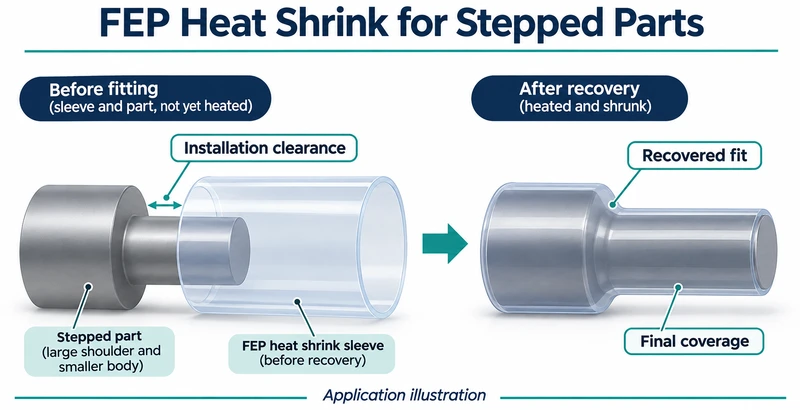
Application illustration. Not a customer photograph, test record or product performance guarantee.
Selecting Tubo termorretráctil FEP for a stepped component requires two dimensional checks: the sleeve must pass over the largest feature, and it must recover sufficiently around the area needing protection. A connector, shoulder or changing diameter makes the complete installation path relevant to size selection.
Map the complete installation path
Identify the largest diameter the sleeve must pass over, including tolerances. Then record the smallest diameter requiring contact, the protected length and any areas that must remain uncovered. A drawing is useful when the component has several steps or an attached connector.
State whether installation happens before or after assembly. Changing the assembly sequence may change the required sleeve size. Include edge conditions: a sharp feature or rough surface may need attention before a sleeve is passed over it.
Compare supplied and recovered dimensions
The minimum expanded ID needs suitable clearance over the largest feature. Account for dimensional tolerances and practical handling. The specified maximum fully recovered ID should be smaller than the smallest diameter requiring contact, leaving recovery capacity.
These checks do not guarantee uniform contact across an abrupt shoulder. A sleeve may bridge a transition. Use a representative installation trial to evaluate the full profile instead of treating a nominal shrink ratio as proof of suitability.
| Component input | Selection purpose |
| Largest feature with tolerance | Establish installation clearance |
| Smallest covered diameter | Assess recovery capacity |
| Shoulder and edge profile | Review transition fit |
| Protected length | Set final coverage target |
| Component heat limits | Define allowable installation conditions |
| Required wall condition | Define recovered inspection criteria |
An illustrative dimensional check
Assume a proposed component has an 8 mm main body and a 12 mm shoulder. These are hypothetical dimensions, not a customer project or a stock specification. The sleeve must pass over the 12 mm feature with suitable clearance and retain recovery capacity around the 8 mm body.
The diameter relationship alone is 12 divided by 8, or 1.5. That does not prove a nominal 1.5 to 1 sleeve will work. Clearance, tolerance, actual expanded limits and actual recovered limits still need review. Compare candidate specifications and trial the selected construction on the full component profile.
Confirm component heat limits
Operating temperature and recovery heating conditions are separate requirements. Provide the heat limits of adhesives, seals, electronics and other sensitive parts. Obtain the recovery instructions for the exact construction being offered, then establish a repeatable heating method through a representative trial.
Record heating arrangement, exposure time and inspection results. Avoid choosing a heating procedure from a generic material temperature limit. The component must remain suitable after the installation process as well as during subsequent service.
Check final coverage and wall condition
Ask about longitudinal change under the proposed recovery conditions. Do not assume the supplied cut length equals final covered length. Confirm both ends remain where required after recovery and cooling. Agree allowable movement around labels, connection points and service access.
The recovered wall can differ along a stepped profile. If minimum insulation thickness matters, define measurement locations and acceptance requirements. Inspect the shoulder, sleeve ends and smallest section. A close fit should not be described as a waterproof or pressure-tight seal without evidence supporting that function.
Request a representative sample
Yozonetech previously helped a customer select FEP heat shrink size according to the outside diameter of an electronic component, and the coordination was completed smoothly. That confirmed experience does not establish a result for a new stepped geometry. Each new profile needs its own dimensional review.
Send a drawing, diameter tolerances, coverage target, wall requirements, component heat limits and quantities. Our engineers can review candidate sizes and identify information still needed for a sample trial. Heat shrink minimum orders are generally 100 m for small sizes and 50 m for larger sizes, with the boundary confirmed at quotation. Samples are free with courier charges collected; preparation and custom lead times depend on the selected specification.
Contact Yozonetech: ptfetube@yozonetech.cn | https://www.chinaptfetube.com/