 +86-13752771911
 E-mail:ptfetube@yozonetech.cn




How to Import FEP Tubing and FEP Heat Shrink Tubing from China
November 2, 2026
Yozonetech
Importing FEP tubing and FEP heat shrink tubing from China starts with a clear product specification, an approved sample and a quotation that defines delivery responsibilities. For buyers sourcing these products from Yozonetech, this guide explains how to move from an enquiry to a purchase order and shipment without leaving critical dimensions, documentation or destination costs unresolved.
Identify the product before requesting a price
A request for “Teflon tube” does not identify a complete specification. State FEP as the material and specify whether you need ordinary extruded tubing or heat shrink tubing. PTFE, FEP and PFA should not be treated as interchangeable purchasing descriptions. If a particular resin brand or grade is required, write it into the enquiry and request confirmation.
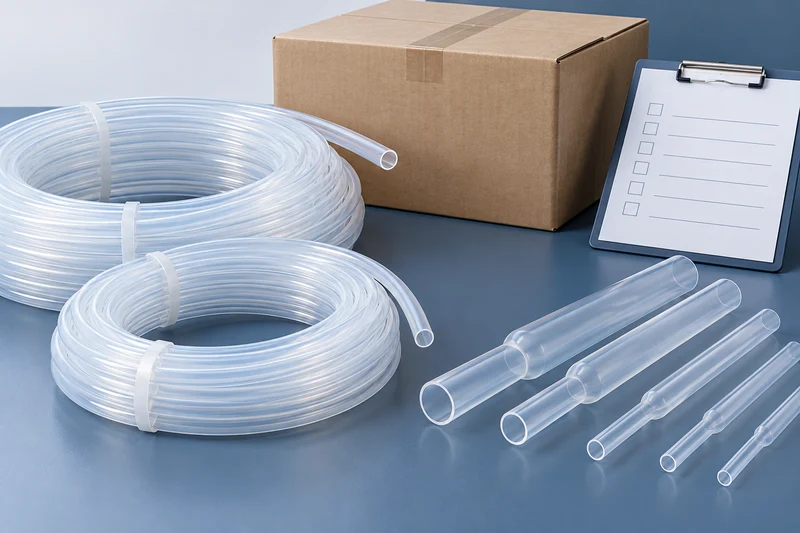
Ordinary extruded FEP tubing is purchased to meet an as-supplied inner diameter, outer diameter and tolerance. FEP heat shrink tubing is purchased with expansion and recovery characteristics so it can be installed over a component and then processed using heat. Ordering one against the other’s dimensions can produce a quotation that appears attractive but does not meet the intended application.
| Purchasing requirement | Extruded FEP tubing | FEP heat shrink tubing |
| Primary size information | Inner diameter and outer diameter with tolerances | Minimum expanded inner diameter and maximum free recovered inner diameter |
| Additional dimensions | Wall thickness and coil or cut length | Recovered wall thickness and length change under stated conditions |
| Application information | Medium, pressure or vacuum, temperature and fittings | Largest installation feature, covered diameter and component heat limits |
| Sample approval | Dimensions, fit and application tests | Installation clearance and controlled recovery on the intended part |
Send an enquiry that can become a purchase specification
For FEP tubing, state dimensions in millimetres or clearly identify inch dimensions. Include tolerances, required length, quantity per size, coil or straight-length format and any cleanliness or packaging requirement. Describe the fluid or environment, operating temperature, pressure or vacuum, bending arrangement and the intended connections. A general material temperature statement is not a finished tube pressure rating.
For FEP heat shrink tubing, provide the largest feature the sleeve must pass over and the minimum diameter of the area to be covered, including part tolerances. Ask for guaranteed expanded and free recovered limits, recovered wall thickness, cut-length tolerance and processing guidance. A nominal shrink ratio alone cannot establish fit. Confirm whether the sleeve is intended for insulation, protection or another function, and identify any acceptance test needed for that function.
Attach a drawing when several dimensions interact. Give the drawing a revision number so the quotation, sample approval and production order refer to the same requirements. Request written approval before any material, size or packaging substitution.
Approve samples before committing to the production quantity
At Yozonetech, samples are available free of charge with courier charges payable by the recipient. Confirm the sample specification, available quantity and courier arrangement before dispatch. The approval sample should represent the intended ordered product; if it does not, record the differences and the remaining validation work.
For extruded tubing, check dimensions using an agreed method that does not excessively deform the sample. Trial the specified fitting and assess the assembly under the intended conditions using an appropriate test procedure. For heat shrink tubing, verify that the sleeve passes the largest feature, then run a controlled recovery trial on a representative component. Check coverage, appearance, wall and component condition against criteria agreed before testing.
Yozonetech has helped an electronic component protection customer select FEP heat shrink tubing based on the outside diameter of the object to be covered, and the coordination was completed smoothly. That experience illustrates the value of sharing component dimensions early; it does not establish a universal sleeve size or heating recipe.
Compare quotations on the same commercial basis
Request unit price, quantity, currency, quotation validity, payment terms, sample arrangements, packing details and an estimated dispatch date. Separate stock availability from manufacturing lead time and transit time. Ask whether inspection reports, special packing or custom cutting are included in the quoted price.
Yozonetech offers extruded fluoropolymer tubing from a minimum order of 1 metre, with many common sizes held in stock. FEP heat shrink tubing normally has a minimum order of 100 metres for small sizes and 50 metres for larger sizes; the size boundary must be confirmed in the quotation. Regular lead time is typically 3–5 days subject to the exact specification and available stock. Custom production and international transport require separate confirmation. Custom dimensions can be discussed following technical review.
Compare the total cost to the agreed destination, not only the price per metre. A useful budgeting worksheet includes goods, origin handling, freight, insurance where applicable, destination handling, clearance, applicable duties and taxes, and delivery to your site. Avoid counting a charge twice when it is already included in the selected delivery term. Treat recoverable tax separately from final cost when your local accounting rules allow it.
Choose a delivery term that matches the shipment
Yozonetech can discuss EXW, FOB, CIF and DDP quotations. State the named place or port and the applicable Incoterms edition in the purchase order. Incoterms allocate transport responsibilities, costs and risk; payment and product acceptance also need their own agreed terms. FOB and CIF are for sea and inland waterway transport, so do not use them casually for an air courier shipment. See the International Trade Administration overview of Incoterms.
Before accepting a delivered quotation, ask which destination charges are included, who will arrange customs clearance and which party will act as importer. Confirm the practical availability of DDP for the destination before treating it as an all-inclusive option. For samples and small orders, obtain courier pricing using the packed dimensions and weight; for larger orders, compare suitable freight options with a forwarder.
Prepare import documents before the shipment leaves
Ask the supplier and your customs broker to agree the product description and document requirements before dispatch. Normally, the shipment planning discussion should cover the commercial invoice, packing list, transport document and any origin documentation required for the transaction. Keep the material, product type, quantities, units and package information consistent across the purchase order and shipping documents.
Do not copy a tariff code from an unrelated seller’s listing. Ask the destination customs broker to review the actual product construction, form and use, confirm the applicable classification and check current duty, tax and other entry requirements. A supplier’s proposed code is useful input, but destination classification still needs review. Free samples should also have appropriate customs descriptions and values determined with the courier or broker.
Requirements differ by destination. For example, the UK government import guide explains importer preparation, commodity codes, customs declarations and duty or VAT, including the GB EORI requirement for imports into England, Wales and Scotland. Buyers in other markets should use their own customs authority and broker rather than applying UK requirements to another country. Recheck the applicable rules when placing the order and before shipment.
Match compliance evidence to the ordered product
Tell Yozonetech which documents your application requires before approving the order. Request applicable REACH and RoHS documentation, relevant food-contact or FDA-related supporting documentation where needed, and the ISO 9001 certificate. Review product scope, material grade, issuing entity, validity where relevant and the intended use covered by each document.
A quality management certificate is not a product-specific test report. Likewise, a food-contact document should not be interpreted as approval for every medical, semiconductor or industrial application. If your purchasing specification requires a batch inspection report or traceability record, define its content and agree availability before production.
Control packing and acceptance on arrival
Specify coil diameter or straight-length packing when shape matters. Ask for protection against crushing, kinking and contamination, and require labels that identify material, size, quantity and a traceable lot reference where agreed. Heat shrink tubing also needs packing and transport arrangements consistent with the supplier’s storage guidance.
Before dispatch, check that the approved specification, quantity and shipping address match the final documents. On receipt, examine the packages, verify labels and quantities, and perform the agreed incoming inspection. Retain the approved sample and inspection record for repeat orders, and agree how shortages or nonconforming material will be handled in the purchase terms.
Start your FEP import enquiry
Send your product type, drawing or dimensions, quantity by size, application conditions, required documentation, destination postal code and preferred delivery term. For heat shrink tubing, include the component dimensions and heat limits. This information allows us to confirm sample options, stock, technical feasibility and a shipment-specific quotation.
Contact Yozonetech at ptfetube@yozonetech.cn, or visit chinaptfetube.com. Explore our FEP tubing and FEP heat shrink tubing product pages to start your specification review.