 +86-13752771911
 E-mail:ptfetube@yozonetech.cn




Expanded and Recovered Inner Diameter in FEP Heat Shrink Selection
October 31, 2026
Yozonetech
Select FEP heat shrink tubing using the guaranteed dimensional limits before and after recovery. The sleeve must first pass over the component, then have enough recovery capability for the required fit. These are separate checks, and both must account for the component’s own dimensional variation.
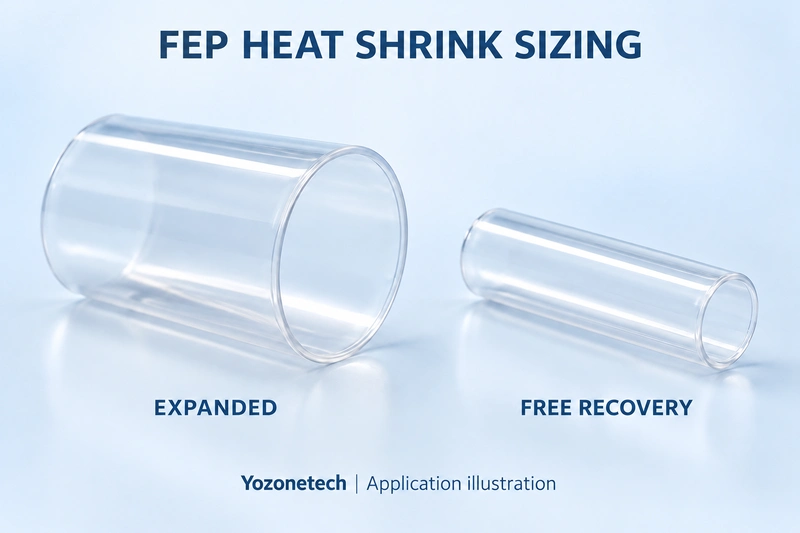
This guide focuses on expanded and recovered inner diameter for FEP heat shrink tubing. All worked dimensions are hypothetical and are not Yozonetech stock specifications or customer measurements. Use them to structure a quotation request, then obtain the limits for the actual product offered.
Distinguish three different conditions
Expanded ID is the bore of the sleeve as supplied before recovery. Free recovered ID is measured after the specified recovery process without a component preventing contraction. Installed ID describes the sleeve around the actual component; its shape is constrained by the part and may vary along its length.
The maximum free recovered ID is useful for checking whether the sleeve can reach the intended section under the defined recovery conditions. It is not a prediction that an installed sleeve will contract through a solid component to that diameter. Likewise, a free recovered wall value is not automatically the installed wall on a larger part.
| Term to request | Why the limit matters | How it is used |
| Minimum expanded ID | Defines the smallest supplied bore | Check passage over the largest component feature |
| Maximum free recovered ID | Defines the largest bore allowed after specified free recovery | Check recovery capability against the smallest covered section |
| Installed dimensions | Reflect the actual part and process | Confirm final envelope and coverage in a representative trial |
Ask the supplier how dimensions are defined and measured. A nominal value without a tolerance or limit is not equivalent to a guaranteed minimum or maximum. Agree the recovery conditions associated with the quoted recovered dimensions.
Measure the full installation path
Find the largest feature the sleeve must pass over, including connectors, shoulders, coatings and any temporary assembly features. Use the maximum possible dimension from the component drawing, not an average of a few convenient measurements. Identify sharp edges, noncircular sections and long insertion paths that may affect handling.
Then find the smallest section that requires a close fit and its minimum dimension. A sleeve may pass a large connector yet be unable to recover onto a much smaller cable. If the geometry includes steps or recesses, diameter checks are only a first screen; the installed sleeve may bridge features or leave gaps.
For a noncircular part, do not reduce the problem to one diameter without review. Share a drawing or representative sample with the supplier. The passage and conformity checks must reflect the actual geometry and installation method.
Set a defined clearance requirement
Let Dpass,max be the largest pass-over diameter and C be the required diametral assembly clearance. A preliminary circular-part check is minimum expanded ID ≥ Dpass,max + C. Diametral clearance is the difference between diameters; radial clearance is half that value for concentric circles.
Choose C for the actual assembly process with the supplier. There is no universal clearance percentage that suits all sleeves, shapes or handling methods. Too little clearance can make installation difficult, while a much larger sleeve still needs sufficient recovery and acceptable installed wall and coverage.
For a close-fit objective, compare maximum free recovered ID with the minimum diameter of the section to be covered. A smaller maximum free recovered ID indicates recovery capability beyond the part size, but it does not establish contact pressure, sealing or functional approval. Ask the supplier about the appropriate recovery margin and constraints.
Work through the component limits
Assume a hypothetical component has a largest feature of 12.00 ± 0.10 mm and a covered section of 10.00 ± 0.10 mm. Assume the assembly team provisionally requests 0.40 mm diametral clearance. These values illustrate arithmetic, not a recommended universal clearance or an approved product design.
The largest pass-over diameter is 12.10 mm. The preliminary expanded-ID requirement is therefore at least 12.10 + 0.40 = 12.50 mm. The smallest covered diameter is 9.90 mm. The proposed sleeves below are invented candidates for screening only.
| Candidate | Minimum expanded ID | Maximum free recovered ID |
| A | 12.50 mm | 10.20 mm |
| B | 12.50 mm | 9.50 mm |
| C | 12.20 mm | 9.50 mm |
A meets the assumed passage-clearance requirement but does not guarantee recovery to the 9.90 mm section. B passes both preliminary diameter checks. C has sufficient recovery capability on these limits but provides only 0.10 mm diametral clearance over the maximum feature, below the assumed 0.40 mm requirement.
B is a candidate for sample evaluation, not an approved assembly. Wall thickness, component heat tolerance, sleeve length, surface condition and actual insertion still need review. A diameter screen should eliminate unsuitable offers without being mistaken for full qualification.
Use shrink ratio as a product descriptor
Yozonetech’s FEP heat shrink page lists nominal 1.3:1 and 1.6:1 options. Obtain the size-specific expanded and recovered limits for the quoted option. The ratio label alone does not state the tolerance bands, wall, length change or recovery process.
Do not divide one nominal catalog diameter by a ratio and treat the result as a guaranteed acceptance limit unless the supplier’s specification explicitly defines it that way. Two offers with the same nominal ratio can still require different dimensional and process checks.
The calculation above deliberately uses actual proposed limits rather than a ratio label. This makes the acceptance questions visible: can the smallest supplied bore pass the largest part, and can the least favorable recovered bore meet the required fit objective?
Check length wall and heating together
Specify the coverage length and any allowable end movement. Ask for longitudinal change under the defined recovery conditions before setting the cut length. Leave any process allowance by agreement; do not assume length remains unchanged during heating.
Request both the relevant wall specification and an installed-envelope check if final OD is critical. A sleeve constrained on a component may not reach its free recovered geometry. Do not use free recovered wall alone to promise the final assembly diameter.
Request a size-specific recovery procedure and confirm that the component, coatings, adhesives and connections can tolerate the process. Service temperature and recovery temperature are different requirements. A catalog heating reference is not an approved equipment setting for every assembly.
Agree a representative sample check
Record sleeve identification, component dimensions, insertion method and recovery conditions. Inspect the resulting coverage, appearance and dimensions against agreed criteria. Where the application requires electrical, environmental or sealing performance, define and perform the appropriate assembly tests; visual contact alone cannot prove a liquid-tight or hermetic seal.
Yozonetech has helped an electronics protection customer choose FEP heat shrink from the object’s outer diameter, with smooth coordination. No project dimensions or heating results have been disclosed. The worked candidates in this article are independent teaching examples, not data from that project.
Send both limiting component dimensions with the enquiry
Provide the maximum pass-over geometry, minimum covered geometry, tolerances, target coverage length, final-envelope limits and allowable process exposure. Ask the quotation to state minimum expanded ID, maximum free recovered ID, wall and length-change information, recommended recovery conditions and any exceptions.
Yozonetech’s heat shrink MOQ is 100 metres for small sizes and 50 metres for larger sizes, with the size boundary confirmed in the quotation. Samples are free with courier charges collected from the recipient. Regular supply is typically 3–5 days subject to specification and stock; custom production and shipping are discussed separately. EXW, FOB, CIF and DDP can be discussed.
Send the drawing and quantity to ptfetube@yozonetech.cn or contact Yozonetech. Request applicable product documentation where needed and agree the sample acceptance criteria before releasing a production order.