 +86-13752771911
 E-mail:ptfetube@yozonetech.cn




Comparing PTFE FEP and PFA Heat Shrink Tubing
octubre 30, 2026
Yozonetech
Choose fluoropolymer heat shrink tubing by checking three things together: whether it can pass over the component, whether it can recover to the required fit and whether the assembly can tolerate the installation process. Only then compare the material’s service capabilities and the evidence required for the application.
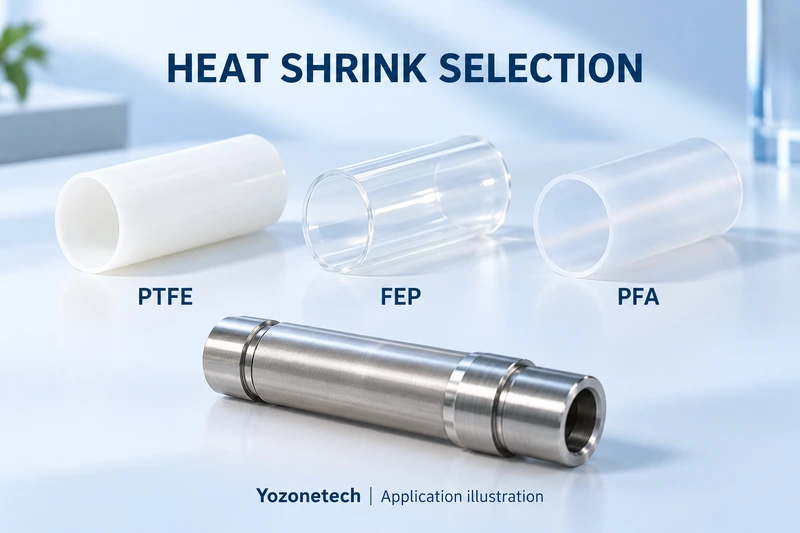
PTFE heat shrink tubing, Tubo termorretráctil FEP y Tubo termorretráctil PFA are related product families with different purchasing considerations. This guide provides a comparison framework, not a universal material ranking or a heating recipe.
Describe the protection requirement first
State what the sleeve needs to do: electrical insulation, surface protection, visibility, chemical exposure resistance or another defined function. Describe the component material, coating, adhesive, solder joints and any heat-sensitive elements. Identify whether the sleeve remains in service or serves a temporary manufacturing purpose.
Record continuous and peak temperatures in use, exposure duration, cleaning media and concentration. If insulation performance is required, specify the applicable voltage and test requirements for the finished assembly. A material dielectric-strength reference alone cannot establish an assembly voltage rating.
Compare the product families with explicit questions
The Yozonetech FEP page lists transparent tubing and nominal 1.3:1 and 1.6:1 options. Its PFA page lists semi-transparent material and customized shrink ratios. The linked PTFE product listing identifies 2:1 and 4:1 options. Treat these as starting points for a quotation; obtain size-specific expanded and recovered dimensions before selection.
| Family | Initial selection question | Evidence to request |
| PTFE | Does the required recovery window suit the geometry and component heat tolerance? | Size-specific recovery procedure, diameter limits and finished wall |
| FEP | Is visual inspection through the sleeve useful, and is the available recovery sufficient? | Appearance sample, expanded and recovered ID limits and heating procedure |
| PFA | Do service and cleanliness requirements justify evaluating this construction? | Product-specific service limits, recovery procedure and relevant cleanliness evidence |
A material name does not prove semiconductor cleanliness, biocompatibility, food-contact suitability or a particular test result. Define any such requirement and request documents that match the actual grade and supplied product. Do not infer it from the industry named in a product title.
Separate installation temperature from service temperature
The current Yozonetech FEP page lists a typical continuous upper service temperature of 205°C and an approximate shrink temperature of 260°C. The PFA page lists 260°C and approximately 300–340°C respectively. These catalog references show why the two questions are different. They are not approved oven settings or guaranteed assembly ratings.
Request the recommended recovery conditions for the quoted size, wall and construction. Heating equipment, exposure time, heat distribution and component thermal mass affect the process. The component itself must tolerate its actual temperature exposure. An air-temperature setting does not necessarily equal the temperature of the sleeve or the enclosed part.
For PTFE, obtain the specific recovery procedure before committing to a heat-sensitive assembly. A high service-temperature material is not automatically easier to install. Follow supplier processing and safety guidance and validate the process on representative samples.
Order expanded and recovered dimensions
Shrink ratio summarizes a dimensional relationship; it does not fully specify a usable sleeve. Request the guaranteed minimum expanded ID, maximum freely recovered ID, recovered-wall range, length-change allowance and the recovery conditions used to define those values.
The expanded bore must pass the largest feature along the installation path with suitable clearance. The recovered capability must suit the smallest section that needs a close fit. Also check the final envelope, length coverage and the possibility of bridging over steps or recesses. A loosely fitted sleeve and a fully conforming sleeve may serve different purposes.
A sleeve recovered around a component is constrained by that component. Its installed wall and geometry may differ from the values measured after free recovery. If final assembly OD is critical, require a representative installation check rather than calculating it from a nominal ratio alone.
Use geometry to eliminate unsuitable options
Consider a hypothetical component with a maximum pass-over diameter of 10.0 mm and a section to be covered measuring 8.0 mm. The table below compares invented specification limits solely to demonstrate the screening method. Neither row is a Yozonetech product code or stock item.
| Hypothetical candidate | Minimum expanded ID | Maximum free recovered ID |
| A | 10.5 mm | 8.5 mm |
| B | 10.5 mm | 7.5 mm |
Both leave 0.5 mm diametral clearance over the assumed largest feature. That clearance still needs a handling check. Candidate A cannot guarantee recovery to contact the 8.0 mm section on these limits. Candidate B passes this preliminary diameter screen, but it is not yet approved: wall, coverage, component tolerances and heating compatibility remain unresolved.
This exercise does not select PTFE, FEP or PFA by itself. Each proposed material must meet the same functional dimensional and process requirements before a commercial comparison is meaningful.
Validate on a representative assembly
Agree a trial using the actual component materials and geometry. Record the sleeve identification, starting dimensions, heating method, time and temperature controls, and the resulting coverage and appearance. Check for gaps, splits, unintended movement and component damage using agreed criteria.
Where required, perform the specified electrical, environmental or other functional tests on the assembly. A visually tight sleeve does not by itself prove a liquid-tight or hermetic seal. If sealing is essential, define a suitable sealing construction and test instead of assuming an ordinary single-wall sleeve provides it.
Yozonetech has supported an electronics protection project by selecting an FEP heat shrink size from the object’s outer diameter, and coordination was completed smoothly. The customer dimensions, heating conditions and test results have not been disclosed. This experience supports the value of sharing geometry; it does not validate the hypothetical dimensions above.
Compare quotations on the same supply basis
Send a drawing with maximum pass-over OD, minimum covered OD, tolerance ranges and coverage length. Add allowed final OD, service conditions, component heat limits, proposed heating equipment, appearance requirements and required documents. Ask the supplier to state expanded and recovered limits, wall, length change, trial quantity and any exceptions.
Yozonetech’s heat shrink MOQ is 100 metres for small sizes and 50 metres for larger sizes; the size boundary is confirmed with the quotation. Samples are free with courier charges collected from the recipient. Regular supply is typically 3–5 days subject to size and stock confirmation, with customization and shipping discussed separately. EXW, FOB, CIF and DDP can be discussed.
Request applicable FDA-related, REACH and RoHS documents and the current ISO 9001 certificate where needed. Review their scope rather than treating them as blanket approval of the finished application. Send your component drawing and requirements to ptfetube@yozonetech.cn or contact Yozonetech to start a size-specific review.