 +86-13752771911
 E-mail:ptfetube@yozonetech.cn




Sourcing PTFE Stainless Steel Braided Hose Assembly Evidence and Acceptance
November 10, 2026
Yozonetech
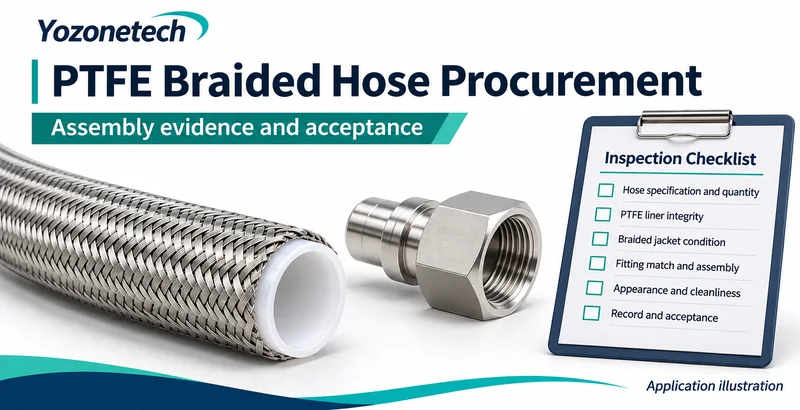
Application illustration. Not a customer photograph, test result or assembly rating.
When sourcing PTFE stainless steel braided hose from China, define whether the supplier is quoting bulk hose, cut lengths or a complete assembly with fittings. A price for reinforced hose without ends cannot be compared directly with a tested assembly. The agreed supply boundary determines which drawings, inspection records and acceptance checks are needed.
Define the complete duty
Provide the fluid identity, concentration, normal and exceptional temperature conditions, working pressure, pulses and any vacuum requirement. Include cleaning media and cleaning cycles. Identify whether the hose is static or moves repeatedly, and show the planned route and support points.
A material temperature range does not establish the working-pressure rating of a hose assembly. Ask for the pressure basis at the selected dimensions and service temperature. If the application involves electrical conductivity or static dissipation requirements, state these explicitly and request a suitable configuration for engineering review. A metal braid alone does not establish the electrical characteristics of the fluid-contacting liner.
Identify the liner and reinforcement
Record the liner material and grade, smooth or convoluted bore, reinforcement material and number of layers. Where stainless steel is specified, make the requested grade explicit. Request corresponding material identification rather than relying on a photograph of metallic braid.
Different liner profiles and reinforcement constructions can produce different installation and service requirements. Compare the exact configurations offered. Do not treat a catalogue family name or an additional braid layer as an automatic guarantee of a higher allowable pressure.
| Purchase input | Evidence or confirmation to request |
| Liner and reinforcement | Material designation and agreed construction |
| Bore and supplied length | Dimensional limits and length measurement basis |
| End connections | Fitting drawing, seal type and material |
| Pressure duty | Rating basis at temperature for the offered assembly |
| Acceptance | Agreed test method, criteria and report scope |
Specify the end connections
State the thread or flange standard, size, sealing arrangement, materials and orientation. For angled fittings, supply a drawing showing the relationship between the two ends. Define overall assembly length using an agreed reference surface at each end.
For bulk hose, clarify who selects and installs fittings and who qualifies the final assembly. Approval of a hose sample does not approve every fitting attached later. For a factory-made assembly, ask the supplier to confirm the compatible hose and fitting combination and the assembly controls applicable to that combination.
Agree testing before the order
Write the required inspection plan into the inquiry. It may include dimensions, visual condition, liner integrity or application-specific pressure checks. The responsible engineer should define any test pressure, medium, duration, acceptance limits and drying or cleanliness requirements. Do not invent a proof-test multiplier from the working pressure.
Distinguish a representative qualification report from routine inspection of delivered assemblies. Check whether the report covers the offered construction, dimensions and end connections. A burst test is destructive and is not the same as an allowable continuous working pressure. A successful pressure check also does not establish unlimited flex life or universal chemical compatibility.
Review packing and receiving checks
Agree minimum packing bend conditions, end protection, identification and any cleanliness precautions. At receipt, verify item numbers, length, fittings and required records. Record visible kinks, damaged braid or open protection before the assembly is installed. Use the supplier’s installation guidance for bend radius, twisting and support requirements.
Illustrative supplier comparison
Application demonstration, not a customer case: two quotations appear to cover the same PTFE braided hose. One includes bulk hose; the other includes fittings and an agreed inspection report. The buyer first aligns the supply scope, drawing and acceptance requirements, then compares the revised offers. No saving, test result or customer outcome is assumed.
Send an assembly inquiry
Send Yozonetech the fluid duty, temperature and pressure conditions, hose dimensions, end-connection drawing, overall length, quantity, movement requirements and inspection needs. If some requirements remain open, our engineers can help identify the information needed for a suitable quotation.
Stock availability for braided hose is confirmed by specification. Free samples are available with courier charges collected from the recipient. Routine preparation is typically 3–5 days subject to the exact specification and stock confirmation; custom assemblies, production and transportation are agreed separately. EXW, FOB, CIF and DDP can be discussed for the destination. Request compliance documents applicable to the ordered product and application.
Contact Yozonetech: ptfetube@yozonetech.cn | https://www.chinaptfetube.com/