 +86-13752771911
 E-mail:ptfetube@yozonetech.cn




PTFE vs FEP Small Bore Tubing Dimensions Routing and Flow Requirements
November 9, 2026
Yozonetech
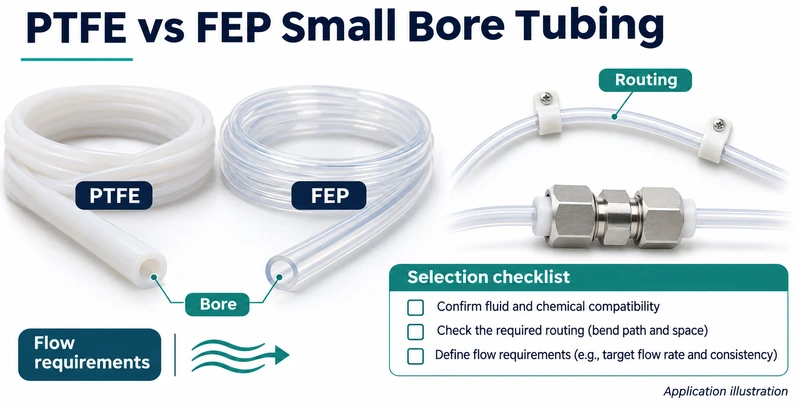
Application illustration. Not a customer photograph, test record or product performance guarantee.
A small bore tube must fit the connection, follow the equipment route and support the required fluid behavior. Comparing PTFE capillary tubing with FEP-Schläuche therefore begins with dimensions and application conditions, rather than a general ranking of the polymers.
FEP offers a transparent option for viewing the line. PTFE is another candidate where its material and construction suit the application. The correct choice needs confirmation for the actual bore, wall, length, fluid and assembly.
Define the purpose of the small bore
Explain whether the tube carries a sample, meters a fluid, protects a fine wire or provides a sliding passage. A fluid line and a protective sleeve can have different critical dimensions even when their nominal bores are similar. Avoid relying on the word “capillary” without specifying the intended function.
For fluid service, provide fluid identity, viscosity information at the operating temperature where available, target flow, pressure conditions and total line length. Include fittings and restrictions in the review. The tube wall material does not by itself determine the delivered flow or response time of the complete system.
Control the bore and the complete flow path
Ask for the ID tolerance and how it will be verified. Review any ovality or local restriction relevant to the route. A tube with the correct nominal outside diameter can still have an unsuitable bore for the intended duty.
For an ideal straight circular bore, internal volume is pi multiplied by ID squared and length, divided by four. As a hypothetical geometry example, a 1 mm ID line that is 1 m long has approximately 0.785 mL of bore volume. This excludes fitting volumes and does not predict real flow, residence-time distribution or sample carryover. Use the actual tolerances and assembly geometry when evaluating the system.
Compare material and visibility requirements
FEP transparency can help an operator view bubbles or the position of a visible fluid interface. It does not measure purity, detect every blockage or confirm a chemical’s identity. Define what the operator actually needs to see and trial visibility with the planned fluid, lighting and wall thickness.
Do not assume a PTFE sample and an FEP sample bend identically because their nominal OD is the same. Compare the proposed constructions along the intended route. Confirm chemical compatibility and temperature suitability separately for the tube, fittings and any seals. General material temperature ranges are not working-pressure ratings for a finished assembly.
| Selection question | Evidence or project input |
| Does the bore suit the duty | ID limits, line length and application evaluation |
| Does the connection fit | OD tolerance and fitting manufacturer’s requirements |
| Can operators see what they need | Trial with fluid, wall and actual lighting |
| Can the route be maintained | Bend guidance, supports and representative routing trial |
| Can the line be accepted | Agreed dimensional and functional checks |
Review the route and interfaces
Document available bend space, moving sections and support points. Obtain guidance for the specific tube size. Inspect whether fitting entry or clamping changes the bore or creates a kink. A sample laid loosely on a desk does not reproduce a confined equipment route.
Agree the fitting model and assembly procedure before approving a tube. Check any minimum insertion length, sealing arrangement or dimensional requirement with the fitting supplier. Where cleanliness matters, agree cutting, end protection and packaging so small openings are protected until installation.
Run a representative application trial
Use the proposed dimensions, line length, fittings and route. Define the fluid and operating conditions with the responsible engineer, along with acceptance criteria for the function being evaluated. A basic water demonstration may not establish suitability for a different viscosity, temperature or chemical exposure.
Application demonstration: an instrument team compares PTFE and FEP sample lines. No actual customer or test result is claimed. The team first fixes the bore, fitting and length, then considers visibility and routing. Each candidate is evaluated against the same agreed requirements, and the decision is recorded with the approved specification.
Prepare a small bore tubing inquiry
Send Yozonetech ID and OD with tolerances, required length, quantity, intended function, fluid conditions and connection details. A drawing or routing sketch helps explain constraints. Ask us to confirm achievable dimensions and any required qualification before treating a proposed size as approved.
Yozonetech supplies extruded tubing from a 1 m minimum order, with many common sizes in stock. Confirm availability for the exact dimensions and grade. Samples are free with courier charges collected from the recipient. Routine preparation is typically 3–5 days subject to specification and stock confirmation; custom production and transportation are agreed separately. EXW, FOB, CIF and DDP can be discussed for the delivery destination. Ask for compliance documents applicable to the ordered product and use.
Contact Yozonetech: ptfetube@yozonetech.cn | https://www.chinaptfetube.com/