 +86-13752771911
 E-mail:ptfetube@yozonetech.cn




PTFE Spiral Wrap vs Heat Shrink for Branching Wire Harnesses
November 6, 2026
Yozonetech
For a branching wire harness, choose the construction before choosing a material name. PTFE spiral wrap and fluoropolymer heat shrink tubing solve different installation problems. The first is open and serviceable. The second is a continuous sleeve after recovery. Neither is automatically the better choice.
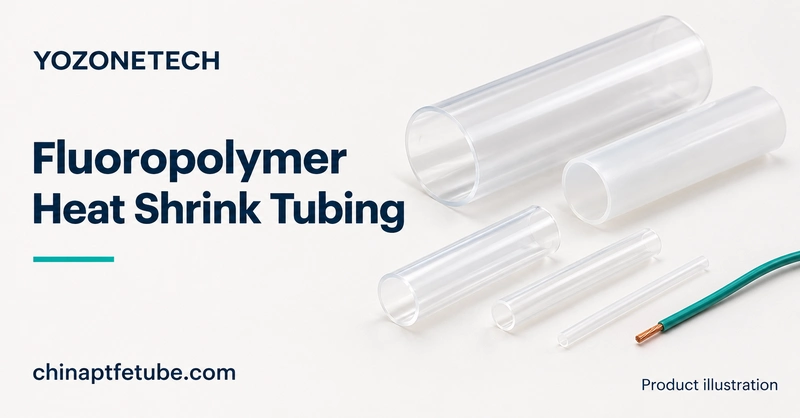
Product illustration comparing an open spiral wrap for branch access with a continuous heat shrink sleeve. It is not a customer installation or a qualified assembly.
Decide whether the harness needs branch access or continuous coverage
Choose open spiral wrap when the assembly needs branches to exit at multiple positions, when wires may be added or serviced, or when the installer needs to apply protection without threading the full harness through a closed sleeve. Choose heat shrink tubing when the protected section has a known geometry and needs continuous coverage around a straight or limited-length segment.
| Project question | Open PTFE spiral wrap | Fluoropolymer heat shrink tubing |
| Branch exits along the length | Designed to allow them | Requires planned termination or a separate sleeve |
| Access after installation | Can be opened and adjusted | Normally forms a continuous recovered sleeve |
| Continuous external coverage | Does not provide it | Can provide it over the selected section |
| Installation data needed | Bundle range pitch branch layout | Largest pass-over OD recovered fit and heating limits |
Write the correct selection data
For spiral wrap, give the assembled bundle diameter range, wrap pitch, branch locations, routing and service expectations. For heat shrink, provide the largest dimension the sleeve must pass over, the target recovered geometry, coverage length, wall requirement and the temperature limits of the component and nearby materials. A nominal cable diameter by itself is insufficient for either product.
The heat shrink selection must also account for the installation process. A sleeve may fit geometrically but still require a heating process unsuitable for the protected component. Confirm the exact recovery specification and validate a representative assembly. Material temperature data should not be treated as an assembly qualification, pressure rating or a general approval for every process.
Use both constructions only when their functions are separate
A harness can use spiral wrap on a branching section and heat shrink on a connector, label area or short straight section. This is a design choice, not a performance claim. Define where one construction stops and the other begins, then agree the appearance and inspection criteria for each. Avoid calling spiral wrap “heat shrink” or using an open wrap as evidence of a sealed sleeve.
Application example clearly identified as hypothetical
Consider a hypothetical control-panel harness that needs three serviceable branch exits along its main run and a short protected segment near a connector. The open section is specified as spiral wrap so branches remain accessible. The connector section is specified separately as heat shrink, with the installation and recovered dimensions reviewed on a representative assembly. No customer name, dimensions, test results or performance outcome are asserted in this example.
Procurement checklist
Before ordering, submit the harness drawing, material request, size range, location of each protected zone, quantity, packaging and destination. For heat shrink, indicate whether the order is a small or large size because MOQ is normally quoted as 100 metres for smaller sizes and 50 metres for larger sizes; confirm the size boundary in the quotation. For custom spiral wrap, confirm MOQ and production lead time for the exact drawing. Samples are free with courier charges collected. Regular availability and 3–5 day dispatch depend on the exact stocked specification.
Use the FEP heat shrink tubing page for a related sleeve option, and contact Yozonetech with your drawing.