 +86-13752771911
 E-mail:ptfetube@yozonetech.cn




Silicone and PVC Reinforced Tubing Selection Guide
October 29, 2026
Yozonetech
Select reinforced tubing around the complete duty cycle: what it carries, how it is cleaned, the pressure or vacuum it experiences and how it is installed. Silicone and PVC describe material families; neither name defines the performance of a finished hose.
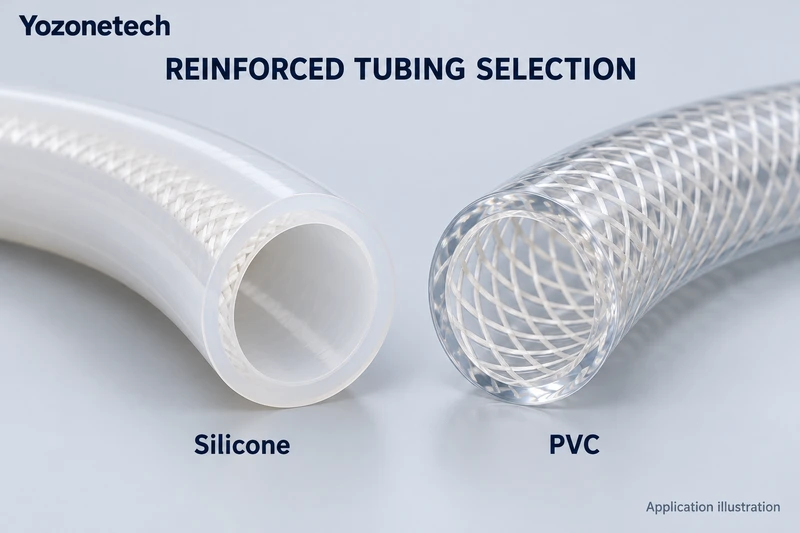
This guide helps buyers compare silicone reinforced tubing and PVC reinforced hose using the same application sheet. It focuses on fluid-transfer tubing with reinforcement. A hot-air duct is a different construction and should not be substituted merely because it also contains silicone.
Start with the working medium and cleaning conditions
Identify the fluid, concentration and any additives. Record normal and peak temperatures, contact duration, flow requirement, pressure transients and any suction duty. Include cleaning and flushing fluids, their concentrations, temperatures, contact times and cycle frequency.
A hose may carry a mild fluid during production but face a more demanding cleaning cycle. State both conditions in the inquiry so the supplier can review the compound, reinforcement and connections together. Do not assume that a silicone hose is compatible with every oil or solvent, or that every PVC formulation has the same restrictions.
Compare the two candidates on the same basis
Silicone can be a candidate where the specified formulation and construction meet demanding thermal or flexibility requirements. Clear PVC constructions can be candidates where visibility and the required operating envelope fit the duty. The selection still needs product-specific evidence for the exact size and use.
| Decision area | Silicone reinforced tubing | PVC reinforced tubing |
| Medium and cleaning | Confirm the compound against all process and cleaning fluids | Confirm the formulation against all process and cleaning fluids |
| Temperature | Request the complete hose limits for continuous and peak exposure | Request the complete hose limits and any temperature-dependent pressure reduction |
| Visibility | Review actual translucency, wall and reinforcement | Review actual transparency, wall and braid density |
| Mechanical duty | Confirm pressure, suction, movement and connection requirements | Confirm pressure, suction, movement and connection requirements |
This is a purchasing comparison, not a universal performance ranking. Do not transfer another manufacturer’s values to a Yozonetech product. For example, the NewAge PVC catalogue separately identifies material properties and product working-pressure information, illustrating why a material reference alone cannot specify an assembly.
State the reinforcement rather than only saying reinforced
Textile braid and a wire helix perform different structural functions. Specify whether you need positive-pressure service, vacuum resistance or both, and request evidence for the proposed construction. A visible textile pattern is not a vacuum rating. A helix also needs review against the required vacuum, bend conditions and temperature.
Ask which material contacts the fluid and how the reinforcement is located within the wall. If a different reinforcement, cover or compound is proposed, record the revision and recheck the relevant requirements. Do not treat additional layers as automatic evidence of a higher approved rating.
Specify ID OD wall and the connection
Use explicit millimetre or inch dimensions. A concentric circular hose with an illustrative 10 mm nominal ID and 16 mm nominal OD has a calculated 3 mm nominal wall envelope. That envelope may include polymer and embedded reinforcement; it is not a measurement of a pure silicone or PVC layer. These example dimensions do not confirm a stock item or a pressure capability.
Define ID and OD tolerances, piece or coil length, quantity and any restrictions on ovality. For a barbed fitting, identify the barb geometry, hose material and clamping method for review. Matching the nominal size alone does not establish retention or sealing performance. Include hose-end photographs or a drawing when replacing an existing connection.
Separate pressure and vacuum requirements
Request the permitted working pressure at the actual fluid and ambient temperatures for the selected hose and connection arrangement. Identify short pressure peaks and repetitive cycling. Burst pressure, proof-test pressure and working pressure serve different purposes; agree which evidence is required.
For suction, state vacuum in an unambiguous form, such as absolute pressure or gauge pressure with an explicit sign and reference. Include hose length, routing and temperature. Review the selected construction’s collapse resistance rather than assuming a pressure-rated hose is automatically suitable for vacuum.
Application exercise for two water lines
The following is an assumed comparison, not a real customer project, a product recommendation or test evidence.
| Assumed requirement | Line A | Line B |
| Process medium | Water at 25°C | Water at 90°C |
| Operating pressure | 4 bar gauge | 1 bar gauge |
| Identified pressure peak | 6 bar gauge | To be defined |
| Cleaning cycle | To be defined | Proposed 120°C cycle with medium and duration still to be defined |
| Common bore request | 10 mm nominal ID | 10 mm nominal ID |
Line A still needs a defined cleaning process and confirmation of the hose and connections at the pressure peak. Line B cannot be selected using the lower normal pressure alone: its proposed cleaning cycle remains incomplete. A silicone candidate would require evidence for that exact cycle; a PVC candidate would also have to demonstrate suitability. Neither is approved by this table.
The useful result is a list of missing information and a specification for sample review. No claim about service-life improvement or successful field operation follows from this exercise.
Plan representative sample acceptance
Agree checks for ID, OD, length, surface condition, reinforcement consistency and the proposed end connection. Test the conditions that matter to the application, using defined methods and acceptance limits. Where cleaning is important, evaluate the agreed cycle and subsequent condition or performance as required by the project.
For food-contact or other qualified uses, request the documents applicable to the exact compound and product. Ask for relevant FDA-related, REACH and RoHS supporting documents and ISO 9001 documentation where required. Check product scope and intended use; do not infer suitability for a medical device or validated cleaning process from a general certificate list.
Confirm supply and quotation scope
Yozonetech holds reinforced tubing stock. Confirm the exact construction, size, available quantity and minimum order in the quotation; the 1 metre MOQ for fluoropolymer extruded tubing should not be assumed for these products. Samples are free, with courier charges payable by the recipient.
The normal stated lead time is 3–5 days, subject to stock, specification and quantity confirmation. Custom dimensions, special packaging and tests need separate confirmation. International transport and import clearance are additional stages. EXW, FOB, CIF and DDP options can be discussed for the shipment.Send the medium, complete temperature and cleaning cycle, pressure or vacuum profile, dimensions, fittings, routing, quantity and destination to ptfetube@yozonetech.cn. Contact Yozonetech to compare available silicone and PVC reinforced constructions against your actual requirements.