 +86-13752771911
 E-mail:ptfetube@yozonetech.cn




PTFE vs FEP Tubing Supplier and Sample Evaluation in China
November 4, 2026
Yozonetech
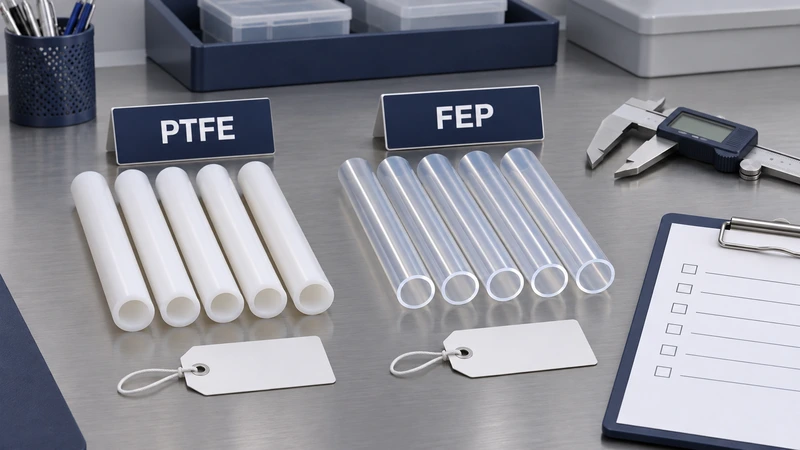
A useful sample of PTFE-Schläuche or FEP-Schläuche must answer a purchasing question: can this supplier repeatedly deliver the product your application requires? A short piece that looks correct is only the beginning. This guide explains how to connect supplier evaluation, sample identification, inspection and a production order so the approved result remains relevant after the first shipment.
Separate material selection from supplier approval
First establish whether PTFE, FEP or both are acceptable candidates for the application. Provide the medium, concentration, temperature range, pressure or vacuum, intended fittings and installation geometry. If a drawing or customer specification names a particular material or grade, do not change it solely because another sample appears similar or is easier to obtain.
Yozonetech offers both PTFE and FEP tubing. Their product pages can help start a specification discussion, but the exact grade, dimensions and service conditions still need review. Do not use colour, clarity or flexibility as the sole material identification method. A material substitution and a supplier change are separate approval decisions, even when the nominal tube size remains unchanged.
Ask how the supplier will control the order
Before requesting samples, ask which specification will govern production and inspection, how lot references connect the product to its records, and how changes will be communicated. Clarify the roles of the selling company, manufacturing site and any external test provider when those details matter to your qualification process. The purchasing record should identify the entity responsible for resolving a nonconformance.
Request evidence matched to the product rather than a large collection of unrelated certificates. Relevant questions include whether a dimensional inspection report can identify the ordered size and lot, whether special packaging can be repeated, and whether material or process changes require prior notification. These are questions to agree with a supplier, not assumptions about its existing controls.
Give every sample an identity
Assign an internal sample reference and record the supplier’s product and lot references, material designation, dimensions, drawing revision and supplied length. Ask whether it is standard stock, a development sample or representative production material. If a sample differs from the proposed order, record the difference before testing.
For example, a straight cut piece can be useful for a fitting trial but may not answer questions about the handling of a long coil. A sample from one wall thickness does not establish the pressure performance of another. Identify which requirements each sample can address and which remain open.
| Approval record | What to capture | Question it answers |
| Sample identity | Material size lot and drawing revision | What was actually evaluated |
| Representativeness | Differences from the production order | Which conclusions can be transferred |
| Inspection plan | Method locations and acceptance limits | How results will be judged |
| Application trial | Assembly and operating conditions | Whether the intended function was assessed |
| Release decision | Approved scope and unresolved items | What may be ordered next |
Agree the inspection method before comparing results
State inner diameter, outer diameter, wall requirements and length tolerances clearly. Agree how samples will be conditioned, where measurements will be taken and how deformation will be controlled during measurement. Appropriate calibrated equipment and a defined method are more useful than a number recorded without context. Do not assume that two different measurement techniques produce directly comparable results on a flexible tube.
Specify the visual defects relevant to the application, such as damage, contamination or unacceptable end condition, with an agreed evaluation method. For cleanliness-sensitive work, define handling and packaging checks as well as any required analytical evidence. A visually clean surface is not a measurement of extractables or particles.
Use a numerical result only within its approved scope
Consider a hypothetical planning example, not a customer result or stock specification. The order drawing requires an outside diameter of 6.00 mm with a tolerance of plus or minus 0.10 mm. The acceptance interval is 5.90–6.10 mm. An illustrative recorded value of 6.04 mm lies within that interval; a value of 6.13 mm lies outside it, before applying any separately agreed measurement-uncertainty decision rule.
These two invented readings explain the decision logic. They do not establish a sampling plan, overall batch acceptance, material identity or functional suitability. Passing OD measurements cannot compensate for a missing ID requirement, wrong material designation or unresolved cleanliness criterion. Keep the dimensions and the remaining approval questions in the same record.
Trial the assembly rather than the loose tube alone
Install representative samples using the intended fittings, tools and routing. Check that the tube can be assembled without unacceptable damage or distortion. Where the application requires pressure, vacuum, thermal, chemical or electrical performance, use a procedure and acceptance limits approved by the responsible engineering team. A generic material temperature reference cannot replace the finished tube and connection assessment.
Record the exact tube identity and all relevant assembly conditions with the trial result. If a fitting, wall thickness or material changes later, review whether the earlier result still applies. Do not improvise hazardous pressure or chemical tests from an online article; the evaluation plan should match the installation and be conducted by suitably equipped personnel.
Resolve failures and open questions before release
Use a clear disposition: approved for the stated scope, revision required, or further evidence required. If a dimension fails, ask for the cause, proposed correction and a new representative sample where appropriate. Repeating a measurement until one result passes does not resolve a discrepancy. Likewise, accepting a deviation for a prototype does not automatically authorize it for a production order.
Retain the approved sample reference, drawing revision and inspection criteria. Request written review before substitutions in material, size or packaging. For the first production shipment, verify that labels and agreed records match the approval, then perform the incoming checks established in the purchase order. A retained sample supports comparison but does not replace numerical limits.
Plan the commercial handover
Yozonetech offers extruded fluoropolymer tubing from 1 metre, with many common sizes in stock. Confirm the required material, dimensions and quantity before placing an order. Samples are free with courier charges payable by the recipient. Regular lead time is typically 3–5 days subject to stock and specification confirmation; custom production and international transport need separate agreement.
Request the applicable REACH, RoHS and FDA-related supporting documentation where relevant to the intended use, and the ISO 9001 certificate. Review document scope separately from sample test results. EXW, FOB, CIF and DDP quotations can be discussed for the shipment, with the destination and included services stated clearly.
Send your drawing, application requirements, sample quantity and intended approval checks to ptfetube@yozonetech.cn. Explore Yozonetech’s PTFE-Schläuche und FEP-Schläuche options at chinaptfetube.com. The goal is a sample approval that becomes a clear, repeatable production requirement.