 +86-13752771911
 E-mail:ptfetube@yozonetech.cn



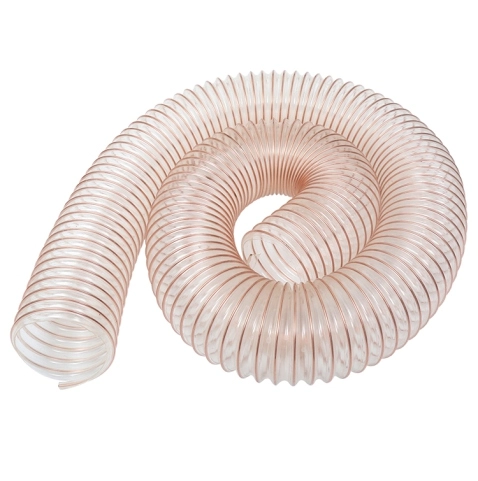
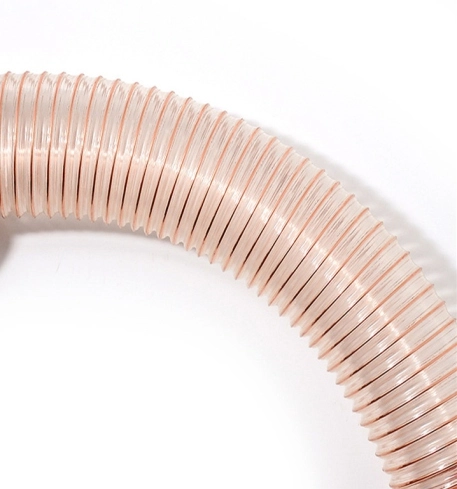
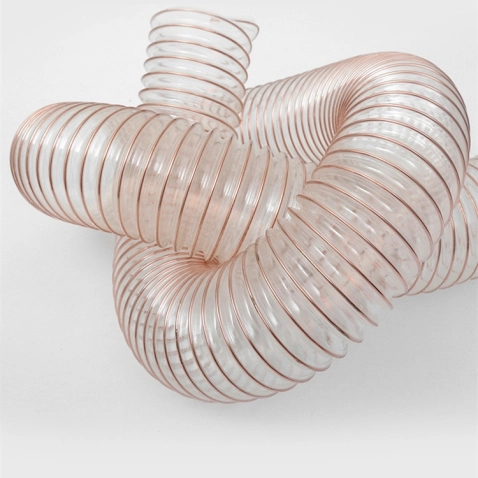
Oil-Resistant & Anti-Static PU Hose
Oil Resistant PU hose Overview
Oil-Resistant & Anti-Static PU Hose is engineered for pneumatic conveying, industrial suction, material handling, and equipment connections where exposure to oils or lubricants is combined with a requirement for controlled electrostatic discharge. Manufactured from specially selected polyurethane, the hose provides a balance of flexibility, abrasion resistance, mechanical durability, and oil resistance while incorporating an electrically dissipative construction.
Its anti-static characteristic is particularly important when dry powders, dust, granules, or other particulate materials move at high velocity through the hose. Friction between the conveyed material and hose wall can generate electrostatic charge. A conductive or dissipative PU formulation helps reduce charge accumulation and provides a controlled path for static dissipation when the complete system is properly grounded.
Compared with conventional PU tubing, this specialized construction is intended for more demanding industrial environments. Different hardness levels, wall thicknesses, reinforcement structures, colors, and dimensions can be developed according to conveying conditions and equipment requirements.
Als ein führendes wholesale ptfe tube Supplier, we engineer our flexible reinforced hoses to withstand extreme temperatures and aggressive chemicals, delivering exceptional durability and pressure resistance for demanding industrial applications worldwide.
Wesentliche Merkmale
- Oil-resistant PU formulation— Designed to maintain mechanical integrity when exposed to oils, lubricants, and selected hydrocarbon-based media.
- Electrostatic dissipation— Conductive or dissipative construction helps control static charge generated during material conveying.
- High abrasion resistance— Suitable for repeated contact with powders, granules, dust, and other abrasive materials.
- Excellent flex fatigue performance— Supports repeated bending and movement in pneumatic and automated equipment.
- Low weight with high mechanical strength— Provides a practical alternative to heavier rigid or rubber conveying lines.
- Smooth bore— Promotes efficient movement of air and particulate materials while reducing internal accumulation.
- Custom electrical resistance— Electrical properties can be engineered according to the required anti-static performance and grounding system.
Technical Specifications
| Parameter | Spezifikation |
| Product Name | Oil-Resistant & Anti-Static PU Hose |
| Main Material | Polyurethane (PU) |
| PU Type | Polyester or Polyether, application dependent |
| Anti-Static Structure | Conductive / dissipative PU formulation |
| Surface Resistance | Application-specific |
| Härte | Typically 80A–98A Shore A, customizable |
| Inner Diameter | Benutzerdefiniert |
| Outer Diameter | Benutzerdefiniert |
| Wanddicke | Benutzerdefiniert |
| Working Temperature | Typically -40°C to +80°C, grade dependent |
| Working Pressure | Size and construction dependent |
| Oil Resistance | Application dependent |
| Reinforcement | Optional |
| Farbe | Black, transparent, translucent, or customized |
| Surface | Smooth |
| Länge | Benutzerdefiniert |
| Connection | Push-in fitting, barb, clamp, cuff, or customized |
| OEM / ODM | Verfügbar |
Electrical resistance and temperature/pressure ratings must be specified according to the selected PU compound and actual system design. Anti-static performance also depends on proper grounding of the hose assembly and connected equipment.
Standard sizes
| Modell | OD (mm) | Wall (mm) | Min. Bneding radius | Suggestion | single length (m) | |
| Working pressure Bar | Negative pressure bar | |||||
| 25 | 32 | 0.60 | 38 | 1.60 | 0.45 | 10-15m |
| 32 | 39 | 0.60 | 47 | 1.60 | 0.40 | 10-15m |
| 38 | 45 | 0.60 | 54 | 1.60 | 0.40 | 10-15m |
| 40 | 47 | 0.60 | 58 | 1.50 | 0.30 | 10-15m |
| 51 | 58 | 0.60 | 69 | 1.40 | 0.35 | 10-15m |
| 60 | 68 | 0.60 | 81 | 1.20 | 0.25 | 10-15m |
| 63 | 71 | 0.60 | 85 | 1.20 | 0.25 | 10-15m |
| 70 | 79 | 0.60 | 94 | 1.10 | 0.23 | 10-15m |
| 76 | 85 | 0.60 | 102 | 1.00 | 0.23 | 10-15m |
| 80 | 89 | 0.60 | 107 | 0.90 | 0.20 | 10-15m |
| 82 | 91 | 0.60 | 109 | 0.90 | 0.20 | 10-15m |
| 90 | 99 | 0.60 | 119 | 0.80 | 0.18 | 10-15m |
| Modell | OD (mm) | Wall (mm) | Min. Bneding radius | Suggestion | single length (m) | |
| Working pressure Bar | Negative pressure bar | |||||
| 102 | 111 | 0.60 | 168 | 0.75 | 0.15 | 10-15m |
| 115 | 124 | 0.60 | 188 | 0.65 | 0.15 | 10-15m |
| 120 | 129 | 0.60 | 193 | 0.65 | 0.15 | 10-15m |
| 127 | 136 | 0.60 | 204 | 0.50 | 0.13 | 10-15m |
| 140 | 149 | 0.60 | 223 | 0.40 | 0.13 | 10-15m |
| 152 | 161 | 0.60 | 241 | 0.30 | 0.12 | 10-15m |
| 159 | 168 | 0.60 | 252 | 0.25 | 0.12 | 10-15m |
| 178 | 187 | 0.60 | 280 | 0.23 | 0.10 | 10-15m |
| 203 | 212 | 0.60 | 318 | 0.22 | 0.09 | 10-15m |
| 254 | 263 | 0.60 | 394 | 0.20 | 0.08 | 10-15m |
| 305 | 314 | 0.60 | 471 | 0.15 | 0.06 | 10-15m |
Materials & Construction
The reinforced flexible hose is manufactured from polyurethane selected for its combination of wear resistance, flexibility, tensile strength, and resistance to repeated mechanical deformation. For oil-exposed environments, the PU formulation can be selected according to the type of oil, lubricant, concentration, temperature, and exposure duration.
The anti-static function is achieved through an electrically dissipative or conductive material system incorporated into the hose rather than relying solely on an external coating. This allows static charge generated during pneumatic conveying or material movement to be controlled through a suitable grounding path.
For demanding applications, polyester-based or polyether-based PU can be considered according to the environment. Polyether PU is often advantageous where moisture and hydrolysis resistance are important, while polyester PU can provide strong mechanical and abrasion performance in many industrial applications.
The hose can be manufactured as a single-wall flexible tube or with additional reinforcement where pressure stability is required. Wall thickness, hardness, conductivity, and reinforcement can be adjusted to meet the requirements of the complete conveying system.
Anwendungen
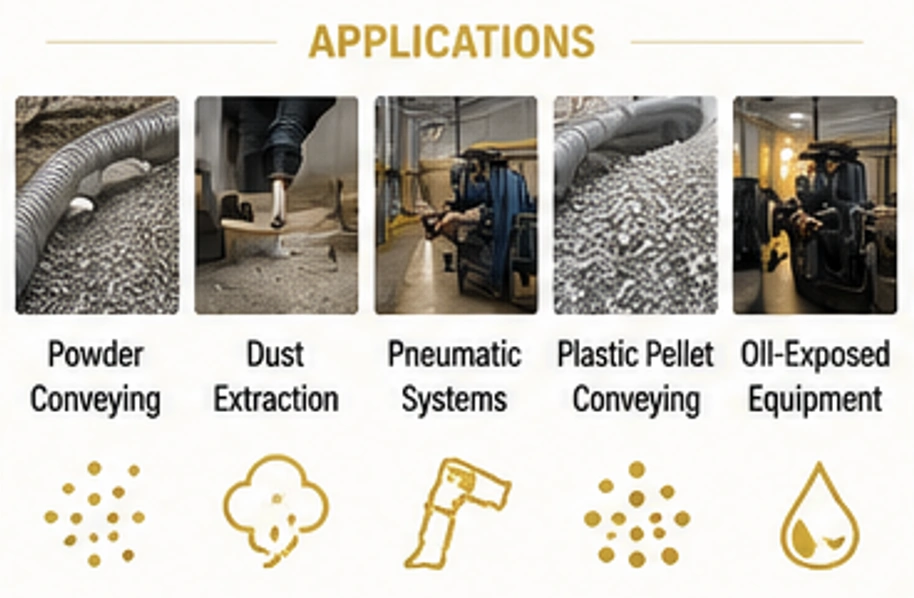
Oil-resistant and anti-static PU hose is commonly used in pneumatic conveying, industrial vacuum systems, powder transfer, plastics processing, woodworking dust collection, automated machinery, and equipment requiring flexible air or material connections.
It is particularly useful in systems conveying dry powders, plastic pellets, granules, dust, and other particulate materials where friction can generate static electricity. The dissipative construction helps reduce charge accumulation when the hose is correctly incorporated into a grounded system.
The oil-resistant formulation also makes the hose suitable for machinery and workshop environments where contact with lubricating oils, cutting fluids, or oil mist may occur. Its flexibility allows connections between moving components, robotic equipment, extraction units, and fixed pipelines.
Typical applications include plastic pellet conveying, CNC dust extraction, pneumatic material transfer, industrial vacuum cleaners, woodworking equipment, air-operated machinery, and selected oil-containing pneumatic environments.
For combustible dust or potentially explosive atmospheres, hose electrical properties must be evaluated as part of the complete system. An anti-static hose alone does not constitute a complete explosion-protection solution.
Manufacturing & Quality Control
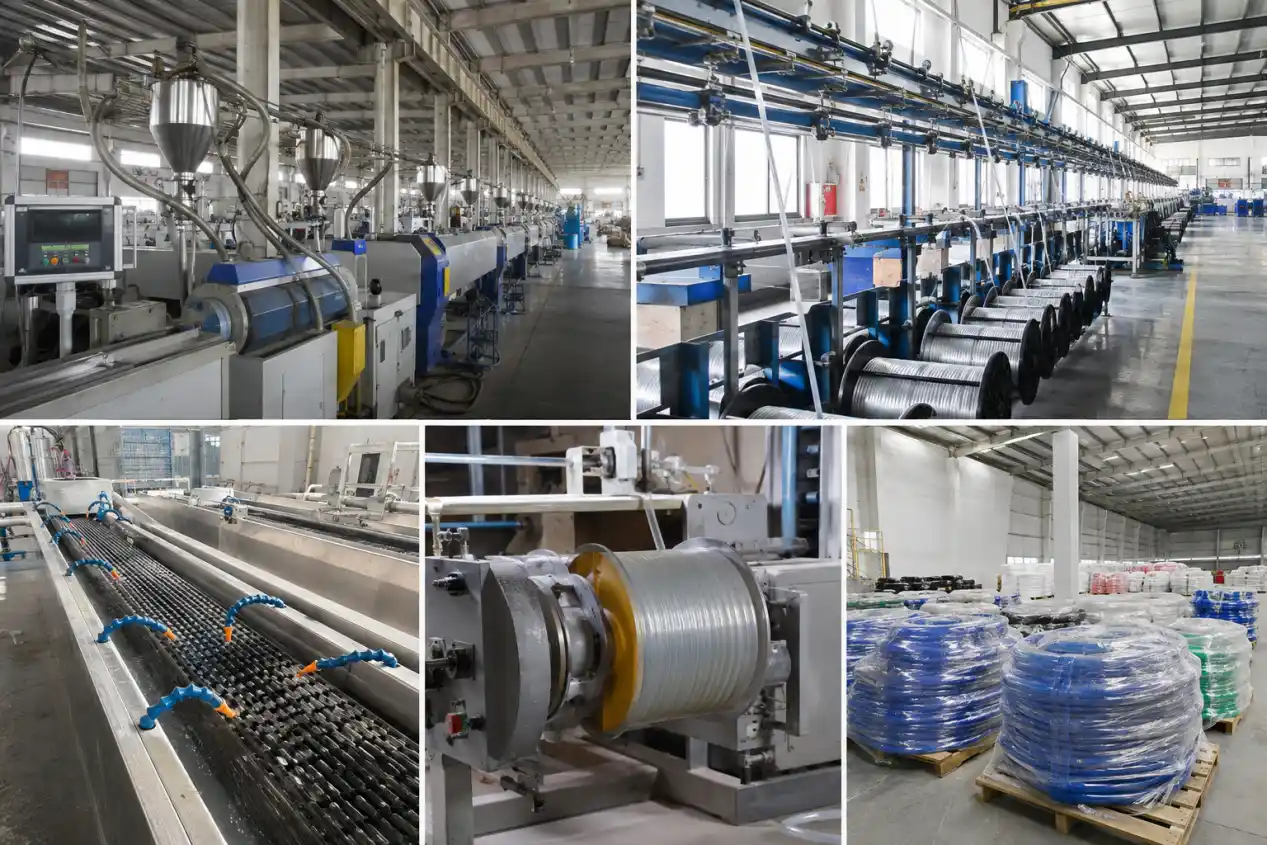
Production begins with the selection and preparation of a PU compound designed to provide the required combination of oil resistance, abrasion performance, flexibility, and electrical behavior. For specialized applications, the formulation is developed around the customer’s conveying medium and operating environment.
The PU material is processed through precision extrusion equipment under controlled thermal and mechanical conditions. Melt temperature, extrusion pressure, die geometry, and line speed are monitored to maintain consistent wall dimensions. For anti-static products, electrical performance depends on maintaining a uniform distribution of the conductive or dissipative component throughout the specified material structure.
During continuous production, inner diameter, outer diameter, wall thickness, surface appearance, and dimensional stability are monitored. Special attention is given to electrical resistance because excessive variation can affect static-dissipation performance. Samples from production batches can be tested using agreed electrical-resistance methods.
Depending on the application, additional quality checks may include hardness, tensile strength, elongation, pressure resistance, leakage, abrasion resistance, oil immersion, heat aging, and repeated-flex testing.
For OEM orders, acceptance criteria can be defined before production, including dimensional tolerances, electrical resistance range, material grade, packaging, and identification requirements. This allows subsequent production batches to be evaluated against the same technical baseline.
Customization / OEM & ODM
Anti-static PU hose should be specified according to the entire conveying system rather than simply selecting a nominal hose diameter. Yozonetech supports OEM and ODM development for customers with specific requirements for electrical properties, oil resistance, pressure, flexibility, and abrasion performance.
The process starts with collecting the conveyed material, oil or chemical exposure, operating pressure, temperature, airflow, hose dimensions, bending frequency, and grounding requirements. The appropriate PU formulation and electrical construction can then be selected.
Customization options include:
- Polyester or polyether PU
- Oil-resistant formulation
- Conductive or dissipative grade
- Target electrical resistance
- Inner and outer diameter
- Wandstärke
- Härte
- Reinforcement structure
- Transparent, translucent, or colored construction
- Hose length and coil configuration
- Fittings and end connections
- Surface printing and private labeling
For new projects, customers can provide an existing hose sample, technical drawing, equipment interface, or electrical-performance requirement. Prototype samples can be produced for dimensional, mechanical, oil-resistance, and electrical evaluation before mass production.
FAQ
1. Why does a pneumatic conveying system need an anti-static hose?
High-speed movement of dry powders, granules, or dust can generate electrostatic charge through friction. An electrically dissipative hose can help prevent excessive charge accumulation when connected to an appropriate grounding system.
2. Is anti-static PU hose suitable for oil exposure?
Yes, selected PU formulations provide good resistance to oils and lubricants. However, resistance varies according to the specific oil type, concentration, temperature, and exposure time, so the actual medium should be confirmed before selection.
3. Is an anti-static hose automatically suitable for explosive environments?
No. Anti-static performance is only one component of a complete safety system. For combustible dust or explosive atmospheres, electrical resistance, grounding, equipment design, and applicable safety requirements must all be evaluated.
4. What is the difference between conductive and dissipative PU?
The distinction is primarily related to electrical resistance and the rate at which charge can be transported away. The appropriate resistance range should be selected according to the conveying system, grounding design, and applicable technical requirements.
5. Can you manufacture PU hose according to a required electrical resistance?
Yes. For OEM projects, the electrical resistance range can be incorporated into the product specification. Customers should provide the intended test method and target resistance where applicable so that production and inspection criteria can be aligned.