 +86-13752771911
 E-mail:ptfetube@yozonetech.cn



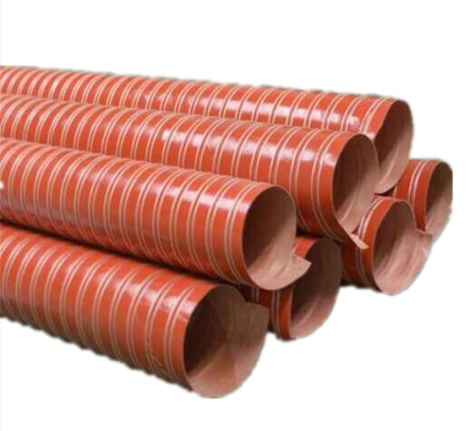
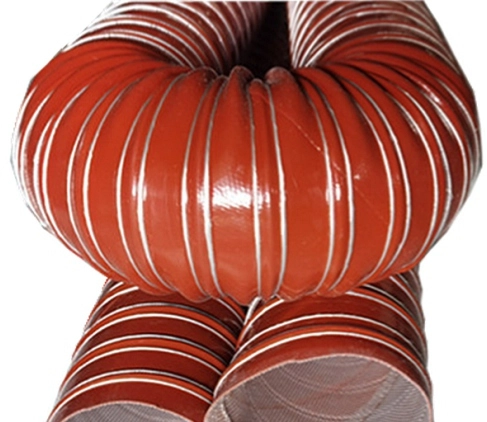
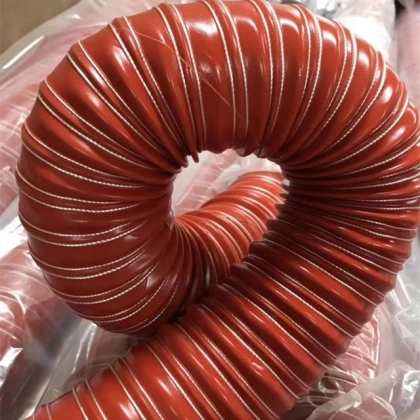
Double-Layer Silicone Fiberglass Cloth Duct
Product Overview
Double-Layer Silicone Fiberglass Cloth Duct is a high-temperature flexible air duct developed for exhaust, ventilation, fume extraction, and thermal-air handling systems operating in demanding environments. The duct is constructed from silicone-coated fiberglass fabric with a double-layer wall, combining heat resistance with mechanical reinforcement and flexible installation characteristics.
Compared with conventional PVC or single-layer fabric ducts, the two-layer construction provides additional protection against heat, abrasion, and mechanical handling while maintaining the flexibility required for routing around machinery. The fiberglass substrate provides dimensional stability and thermal resistance, while the silicone coating forms a protective barrier against moisture, hot air, and environmental exposure.
Its flexible structure allows the duct to be compressed, bent, and routed through restricted spaces, making it particularly suitable for industrial equipment where rigid metal ducting is difficult to install. Various diameters, lengths, connection configurations, and reinforcement options can be developed for specific operating conditions.
Como líder PTFE Hose Supplier, we engineer our flexible reinforced hoses to withstand extreme temperatures and aggressive chemicals, delivering exceptional durability and pressure resistance for demanding industrial applications worldwide.
Características principales
- Double-layer fabric construction— Provides greater structural integrity and protection than single-layer flexible fabric ducts.
- High-temperature capability— Silicone-coated fiberglass fabric is suitable for demanding hot-air and exhaust applications.
- Flexible routing— Can be bent around machinery, frames, and confined installation areas without rigid elbows.
- Good thermal insulation characteristics— The fabric-based wall reduces direct heat transfer compared with thin polymer tubing.
- Flame-resistant fiberglass substrate— Fiberglass provides a stable reinforcement base for high-temperature applications.
- Strong resistance to environmental exposure— Silicone coating provides protection against moisture and general industrial conditions.
- Custom-engineered dimensions— Diameter, length, wall construction, reinforcement, and end connections can be adapted to equipment requirements.
Technical Specifications
| Parámetro | Especificación |
| Product Name | Double-Layer Silicone Fiberglass Cloth Duct |
| Base Fabric | Fiberglass cloth |
| Coating | Silicone rubber |
| Wall Construction | Double-layer silicone-coated fiberglass fabric |
| Inner Diameter | A medida |
| Longitud | A medida |
| Working Temperature | Application dependent |
| Short-Term Temperature | Application dependent |
| Flexibilidad | Flexible |
| Reinforcement | Fabric / optional structural reinforcement |
| Color | Commonly red, black, gray, or customized |
| Surface | Silicone-coated fabric |
| Connection | Clamp, cuff, flange, sleeve, or customized |
| Compression | Available depending on construction |
| Flame Resistance | Available according to material specification |
| OEM / ODM | Disponible |
Temperature capability depends on silicone formulation, fiberglass grade, duct construction, airflow, exposure duration, and installation conditions. Final temperature ratings should be confirmed for the specific application.
Standard Sizes
| Modelo | OD (mm) | Wall (mm) | Min. bending | Suggestion | Single length (m) | |
| Working pressure bar | Negative pressure bar | |||||
| 25 | 29 | 0.8 | 43 | 2.7 | 0.7 | 4 |
| 32 | 36 | 0.8 | 54 | 2.7 | 0.64 | 4 |
| 38 | 43 | 0.8 | 64 | 2.6 | 0.6 | 4 |
| 51 | 56 | 0.8 | 84 | 2.5 | 0.51 | 4 |
| 63 | 68 | 0.8 | 102 | 2.3 | 0.46 | 4 |
| 76 | 81 | 0.8 | 121 | 2.1 | 0.42 | 4 |
| 83 | 88 | 0.8 | 132 | 2 | 0.4 | 4 |
| 89 | 94 | 0.8 | 141 | 2 | 0.38 | 4 |
| 102 | 107 | 0.8 | 160 | 1.9 | 0.35 | 4 |
| Modelo | OD (mm) | Wall (mm) | Min. bending | Suggestion | Single length (m) | |
| Working pressure bar | Negative pressure bar | |||||
| 114 | 120 | 0.8 | 180 | 1.6 | 0.29 | 4 |
| 127 | 133 | 0.8 | 199 | 1.5 | 0.26 | 4 |
| 152 | 158 | 0.8 | 237 | 1.3 | 0.18 | 4 |
| 165 | 172 | 0.8 | 258 | 1.2 | 0.15 | 4 |
| 178 | 184 | 0.8 | 276 | 1 | 0.13 | 4 |
| 203 | 209 | 0.8 | 313 | 0.8 | 0.1 | 4 |
| 254 | 260 | 0.8 | 390 | 0.6 | 0.08 | 4 |
| 305 | 311 | 0.8 | 466 | 0.5 | 0.07 | 4 |
Materials & Construction
The duct is manufactured from fiberglass fabric coated with silicone rubber and assembled as a double-layer flexible structure. Fiberglass serves as the primary reinforcement substrate because of its ability to retain mechanical integrity at elevated temperatures. The silicone coating protects the fabric from moisture, surface contamination, and environmental exposure while providing flexibility to the finished duct.
The two-layer configuration increases the material thickness and creates a more robust barrier between the hot airflow and the surrounding environment. It also improves resistance to handling damage during installation and repeated repositioning.
Depending on the required diameter and operating conditions, the fabric layers can be configured with different weights, weave structures, coating thicknesses, and reinforcement arrangements. Additional structural elements may be incorporated when the duct needs improved shape retention or resistance to external compression.
The resulting construction is substantially different from thermoplastic hoses: it is primarily engineered as a high-temperature flexible ducting system, where thermal performance, airflow management, installation flexibility, and fabric durability are more important than conventional fluid-pressure performance.
Aplicaciones
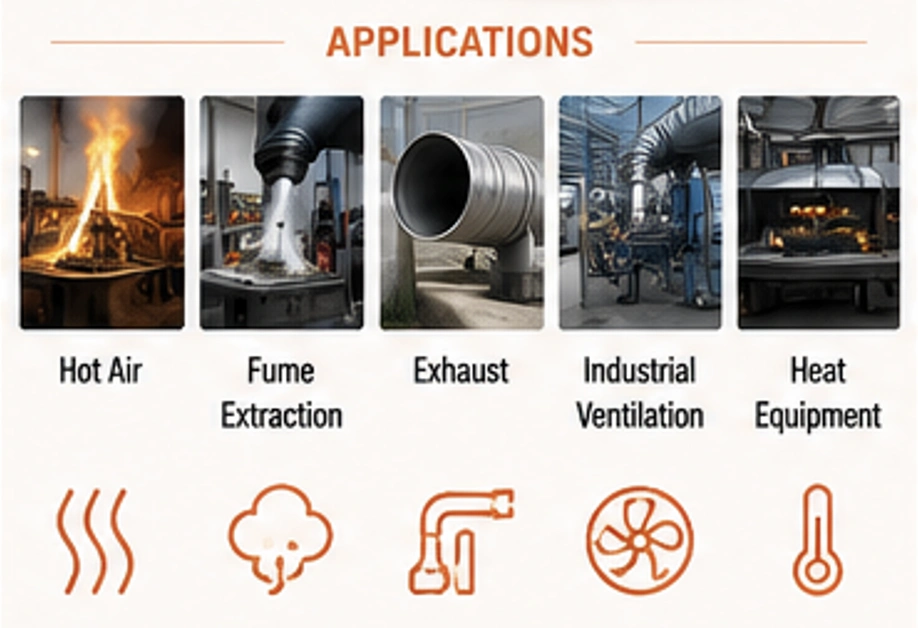
Flexible industrial hose is designed primarily for the movement of hot air, exhaust gases, fumes, and thermally loaded air streams. It is commonly used around industrial heaters, ovens, furnaces, dryers, engines, generators, welding equipment, exhaust systems, and specialized ventilation machinery.
The duct is particularly useful when the connection between two components requires flexibility and cannot be accommodated efficiently with rigid metal ducting. Its fabric construction allows it to follow equipment movement and complex routing paths while reducing the number of rigid bends and intermediate connections.
Typical applications include hot-air extraction, engine compartment ventilation, welding fume extraction, industrial oven exhaust, heating equipment, thermal processing machinery, and mobile ventilation systems.
Before selection, the actual gas composition, temperature, airflow velocity, installation length, bending radius, and exposure duration should be considered. Applications involving corrosive chemicals, direct flame, molten materials, or highly abrasive particles may require a specially formulated construction.
Manufacturing & Quality Control
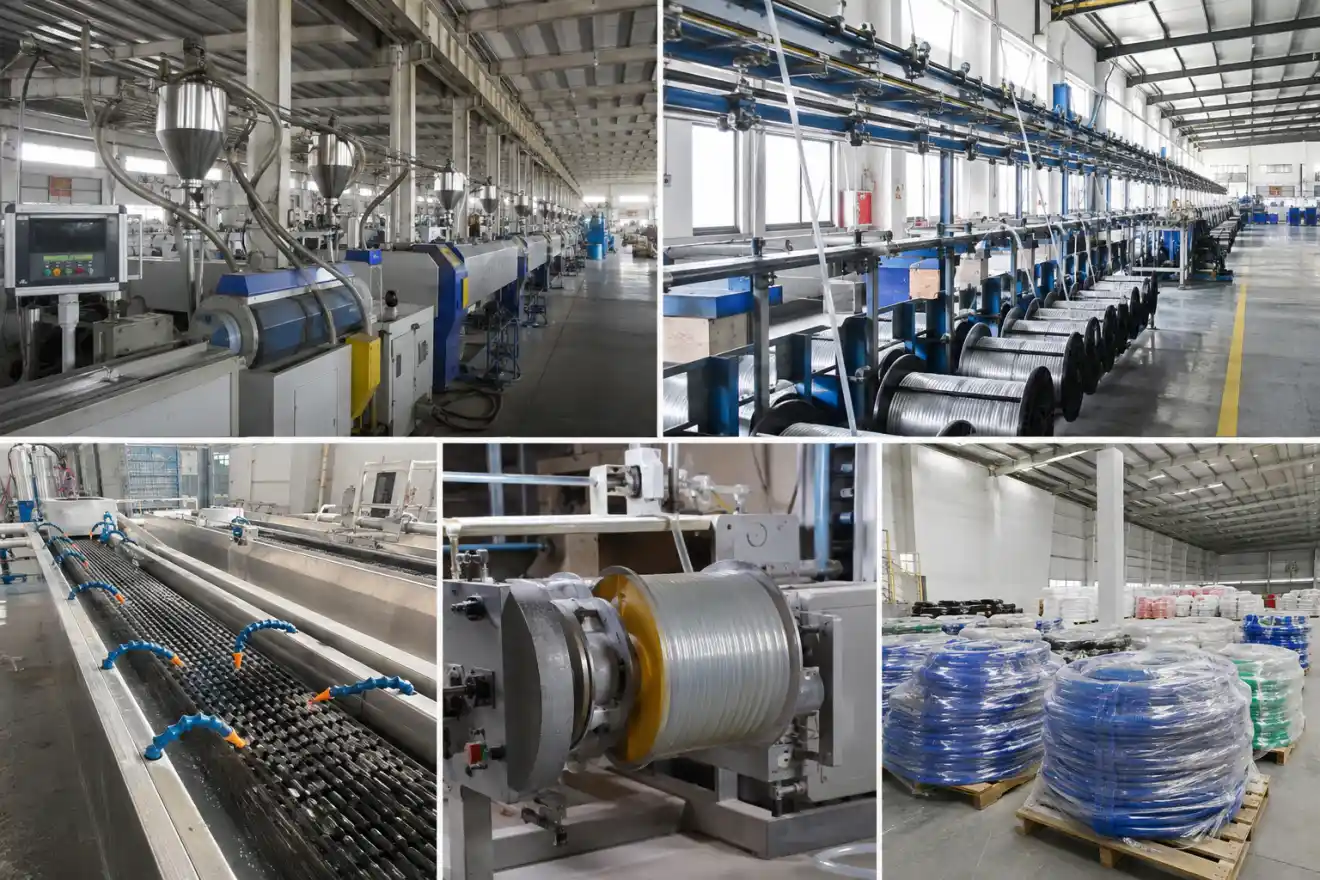
Production of the double-layer silicone fiberglass duct involves controlled preparation of the fiberglass fabric, silicone coating, layer forming, cutting, joining, reinforcement, and final dimensional inspection. Fiberglass cloth is selected according to the required thermal and mechanical performance before the silicone coating process.
During coating, silicone is applied uniformly to the fiberglass substrate to achieve consistent coverage and stable adhesion. Coating thickness is controlled according to the intended application because it affects flexibility, surface protection, and overall durability. After coating, the fabric is processed into the required duct configuration.
The double-layer structure is assembled with controlled overlap and joining methods to maintain consistent wall construction around the circumference. For reinforced or shaped ducts, the structural components are positioned according to the specified pitch and geometry. Particular attention is given to the transition between the duct body and end connections, as these areas experience concentrated mechanical loads during installation.
Finished ducts undergo dimensional inspection covering inner diameter, length, wall appearance, connection dimensions, and construction uniformity. Visual inspection checks for coating defects, exposed fabric, uneven seams, delamination, and mechanical damage. Where required, samples can undergo temperature exposure, flexibility evaluation, dimensional stability testing, and connection-strength assessment.
Each production order can be manufactured against an approved drawing or technical specification to maintain consistency between batches.
Customization / OEM & ODM
High-temperature ducting often requires customization because equipment layouts, exhaust temperatures, connection dimensions, and available installation space vary considerably. Yozonetech supports development of double-layer silicone fiberglass ducts according to drawings, samples, or detailed application requirements.
The customization process starts with confirmation of the operating temperature, airflow, duct diameter, required length, installation route, connection dimensions, and surrounding environment. These factors determine the appropriate fabric grade, silicone coating, wall construction, and reinforcement method.
Customization options include:
- Inner diameter and overall length
- Fiberglass fabric grade and weight
- Silicone coating formulation and thickness
- Single or double-layer construction
- Reinforcement structure
- Color and surface marking
- Cuffs, sleeves, clamps, flanges, and end fittings
- Connection geometry
- Packaging and private labeling
For OEM projects, customers can provide an existing duct, engineering drawing, photographs, or equipment interface dimensions. Samples can then be developed for installation and thermal-performance evaluation before the final construction is approved for series production.
PREGUNTAS FRECUENTES
1. What is the advantage of using two fiberglass layers?
The double-layer structure provides a more robust thermal and mechanical barrier than a single fabric layer. It can improve durability during installation and repeated handling while providing additional protection around hot-air systems.
2. Is the duct suitable for continuous high-temperature operation?
It can be designed for continuous elevated-temperature service, but the allowable temperature depends on the silicone formulation, fiberglass specification, airflow, and exposure duration. The actual operating conditions should be provided before selecting the final construction.
3. Can this duct replace metal exhaust ducting?
In applications where flexibility is required, it can serve as a flexible connection or duct section. However, rigid metal ducting may remain preferable for long unsupported runs, very high mechanical loads, or applications requiring high structural rigidity.
4. Can you manufacture special end connections?
Yes. Cuffs, sleeves, clamps, flanges, and other interface configurations can be customized according to the customer’s equipment dimensions and installation method.
5. Can the duct be manufactured from a customer sample?
Yes. We can evaluate a supplied sample or drawing and develop a corresponding double-layer construction, subject to confirmation of the required temperature, dimensions, and application conditions.